What We Have Here Is Failure to Communicate
| Cool Mitt Luke | |
|---|---|
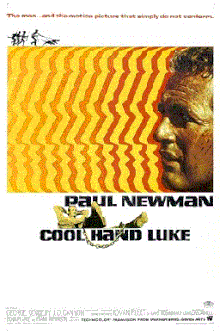 Theatrical release poster by Beak Gold | |
| Directed by | Stuart Rosenberg |
| Screenplay by |
|
| Based on | Absurd Hand Luke past Donn Pearce |
| Produced past | Gordon Carroll |
| Starring |
|
| Cinematography | Conrad Hall |
| Edited by | Sam O'Steen |
| Music past | Lalo Schifrin |
| Production | Jalem Productions |
| Distributed by | Warner Bros.-Seven Arts |
| Release date |
|
| Running time | 126 minutes |
| Country | United States |
| Linguistic communication | English |
| Budget | $3.2 one thousand thousand[1] |
| Box part | $16.2 million[2] |
Cool Manus Luke is a 1967 American prison house drama film directed by Stuart Rosenberg,[3] starring Paul Newman and featuring George Kennedy in an Oscar-winning functioning. Newman stars in the title office as Luke, a prisoner in a Florida prison military camp who refuses to submit to the system. Gear up in the early 1950s, information technology is based on Donn Pearce's 1965 novel Cool Paw Luke.
Roger Ebert called Cool Hand Luke an anti-establishment movie shot during emerging popular opposition to the Vietnam War. Filming took identify within California's San Joaquin River Delta region; the ready, imitating a prison house farm in the Deep South, was based on photographs and measurements made by a crew the filmmakers sent to a Road Prison in Gainesville, Florida. The moving picture uses Christian imagery.
Upon its release, Cool Hand Luke received favorable reviews and was a box-office success. Information technology cemented Newman's status every bit one of the era's top actors, and was chosen the "touchstone of an era". Newman was nominated for the University Award for Best Actor, Kennedy won the Academy Award for All-time Supporting Histrion, Pearce and Pierson were nominated for the Academy Award for Best Adapted Screenplay, and Lalo Schifrin was nominated for the Academy Accolade for Best Original Score. In 2005, the U.s. Library of Congress selected the motion-picture show for preservation in the National Moving picture Registry, considering it "culturally, historically, or aesthetically significant".[4] [5] The film has a 100% rating on the review aggregator website Rotten Tomatoes, and the prison warden's (Strother Martin) line in the picture, which begins with "What we've got here is failure to communicate", was listed at number 11 on the American Picture show Institute's 100 Years... 100 Movie Quotes list.
Plot [edit]
In early on 1950s Florida, busy World War Two veteran Lucas "Luke" Jackson (Paul Newman) is arrested for cutting parking meters off their poles i drunken nighttime. He is sentenced to ii years on a concatenation gang in a prison military camp run by a stern warden known every bit the Captain (Strother Martin), along with Walking Boss Godfrey (Morgan Woodward), a taciturn rifleman nicknamed "the man with no eyes" considering he e'er wears mirrored sunglasses. Carr (Clifton James), the floorwalker, tells the new prisoners the rules. Fifty-fifty small-scale violations are punished past "a night in the box", a small square room with limited air and very niggling room to motion.
Luke refuses to notice the established pecking order amid the prisoners and quickly runs afoul of the prisoners' leader, Dragline (George Kennedy). When the pair have a boxing friction match, the prisoners and guards lookout with involvement. Luke is severely outmatched by his larger opponent only refuses to accede. Eventually, Dragline refuses to continue the fight, but Luke'south tenacity earns the prisoners' respect and draws the guards' attention. He afterwards wins a poker game by backbiting with a hand worth nil. Luke says, "sometimes, nothing can be a real cool hand", prompting Dragline to nickname him "Cool Mitt Luke".

Luke and the chain gang finish paving the road
After a visit from his sick mother, Arletta (Jo Van Armada), Luke becomes more optimistic about his situation. He continually confronts the Captain and the guards, and his sense of humor and independence prove both contagious and inspiring to the other prisoners. Luke's struggle for supremacy peaks when he leads a work crew in a seemingly impossible but successful effort to complete a route-paving job in less than a day. The other prisoners start to idolize him later on he makes and wins a spur-of-the-moment bet that he can consume 50 hard-boiled eggs in an hour.
I solar day, Luke picks upwards a rattlesnake from the grassy ditch and holds it up for Godfrey to shoot with his rifle, killing it. Luke tosses the dead snake to the dominate equally a joke earlier he easily him his walking cane. Luke tells Godfrey, "Man, you sure tin can shoot." Dragline advises Luke to be more careful with the "man with no eyes". A rainstorm ends the solar day's piece of work prematurely. Before he joins the other prisoners in the truck, Luke shouts to God, testing Him. That evening, Luke receives notice that his mother has died.
The Captain anticipates that Luke might effort to escape to attend his mother'due south funeral and has him locked in the box. After existence released, Luke is told to forget about his mother now that her burial is completed, only he becomes determined to escape. Under cover of a Fourth of July celebration, he makes his initial escape attempt. He is recaptured past local law and returned to the chain gang, simply ane of the bloodhounds sent after him dies of heat and overexertion. The Captain has Luke fitted with leg irons and delivers a warning speech to the other inmates, maxim, "What we've got here is failure to communicate. Some men you merely can't reach. So you go what we had hither last week, which is the way he wants it. Well, he gets it. And I don't similar it any more than you men."
A short time afterward, Luke escapes again by deceiving the guards while taking a break to urinate and removes his shackles with an axe at a nearby house. He spreads curry powder and chili powder across the footing to continue the guard dogs from post-obit his olfactory property, causing them to sneeze. While gratuitous, Luke mails Dragline a mag that includes a photograph of himself with two beautiful women. He is shortly recaptured, beaten, returned to the prison camp, and fitted with ii sets of leg irons. The Captain warns Luke that he will be killed on the spot if he ever attempts to escape once again.
Luke becomes bellyaching by the other prisoners fawning over the magazine photo and says he faked it. At first, the other prisoners are angry, but when Luke returns after a long stay in the box and is punished by beingness forced to eat a massive serving of rice, the others help him finish information technology.
As further penalty for his escape, he is forced to repeatedly dig a grave-sized hole in the prison campsite grand, fill up it back in, and is then beaten. The prisoners discover his persecution, singing spirituals. Finally, as the other prisoners lookout man from the windows of the bunkhouse, an exhausted Luke collapses in the pigsty, begging God for mercy and pleading with the bosses not to hit him again. Believing Luke is finally broken, the Captain stops the penalization. Dominate Paul warns Luke that he will exist killed if he runs away again, which Luke tearfully promises not to do. The prisoners begin to lose their idealized prototype of Luke, and one tears upwardly Luke's photograph with the women.

Luke defies the authorities for the last fourth dimension
Working on the chain gang again, seemingly cleaved, Luke stops working to give water to a prisoner. Watched by the disappointed prisoners, he runs to one of the trucks to fetch Godfrey'southward rifle for him. Later Godfrey shoots a snapping turtle, Luke retrieves information technology from a slough for him, complimenting him on his shot. Luke is ordered to take the turtle to the truck but steals the truck and the other trucks' keys. In the excitement of the moment, Dragline jumps in the truck and joins Luke in his escape. After abandoning the truck, Luke tells Dragline that they should part ways. Dragline reluctantly agrees and leaves. Luke enters a church, where he talks to God, whom Luke blames for sabotaging him so he cannot win in life. Moments later, police cars arrive. Dragline tells Luke that the police and bosses have found them but promised non to hurt Luke if he surrenders peacefully.
Instead, Luke opens a window door, facing the constabulary, and mocks the Captain by repeating his earlier speech: "What we've got here is a failure to communicate". Godfrey shoots him in the cervix. Dragline carries Luke outside and surrenders, just charges at Godfrey and strangles him until he is beaten and subdued past the guards. While Luke is loaded into the Helm'south car, Dragline tearfully implores him to live.
Against the local police's protests, the Captain decides to take Luke to the distant prison infirmary instead of the local hospital, ensuring Luke will not survive the trip. As the car drives away, a semi-conscious Luke weakly smiles while the tires crush Godfrey's sunglasses. After Luke's implied death, Dragline and the other prisoners fondly reminisce well-nigh him.
Some time later, the prison coiffure works near a rural intersection close to where Luke was shot, with Dragline at present wearing leg irons, and a new Walking Boss supervising. As the camera zooms out, the torn photo of Luke grin with the two women has been taped back together and is superimposed on a bird's-eye view of the cantankerous-shaped road junction.
Cast [edit]
- Paul Newman as Lucas "Luke" Jackson
- George Kennedy as "Dragline"
- Strother Martin as The Captain
- Jo Van Fleet as Arletta Jackson
- Joy Harmon every bit Lucille
- Morgan Woodward as Walking Boss / Godfrey
- Luke Askew as Dominate Paul
- Robert Donner as Boss "Shorty"
- Clifton James as Carr, The Floor Walker
- John McLiam as Boss Keen
- Andre Trottier equally Boss Popler
- Charles Tyner every bit Boss Higgins
- J. D. Cannon equally "Society Red"
- Lou Antonio equally "Koko"
- Robert Drivas equally Steve "Loudmouth Steve"
- Marc Cavell every bit "Rabbitt"
- Richard Davalos as Dick "Bullheaded Dick"
- Warren Finnerty as "Tattoo"
- Dennis Hopper every bit Babalugats
- Wayne Rogers equally "Gambler"
- Harry Dean Stanton as "Tramp"
- Ralph Waite as "Alibi"
- Anthony Zerbe as "Domestic dog Boy"
- Buck Kartalian as "Dynamite"
- Joe Don Bakery equally "Logroller" (uncredited)
- James Gammon as "Sleepy" (uncredited)
Production [edit]
Script [edit]
Pearce, a merchant seaman who later on became a counterfeiter and safe cracker, wrote the novel Cool Hand Luke about his experiences working on a concatenation gang while serving in a Florida prison. He sold the story to Warner Bros. for $lxxx,000 and received another $15,000 to write the screenplay.[6] After working in television for over a decade, Rosenberg chose it to make information technology his directorial debut in movie theater. He took the idea to Jalem Productions, owned by Jack Lemmon.[seven] Since Pearce had no experience writing screenplays, his draft was reworked by Frank Pierson. Conrad Hall was hired as the cinematographer,[eight] while Paul Newman's blood brother, Arthur, was hired every bit the unit production manager.[ix] Newman'southward biographer Marie Edelman Borden wrote that the "tough, honest" script drew together threads from earlier movies, especially Hombre, Newman's earlier movie of 1967.[10] Rosenberg altered the script'due south original catastrophe, adding "an upbeat ending that would reprise Luke'south (and Newman'south) trademark grin."[11]
Casting [edit]
Paul Newman's character, Luke, is a decorated state of war veteran who is sentenced to serve ii years in a Florida rural prison. He constantly defies the prison government, becoming a leader among the prisoners, equally well as escaping multiple times.[12] While the script was being developed, the leading role was initially considered for Jack Lemmon or Goggle box Savalas. Newman asked to play the leading part later hearing about the project. To develop his graphic symbol, he traveled to West Virginia, where he recorded local accents and surveyed people'south beliefs.[viii] George Kennedy turned in an University Award-winning performance every bit Dragline, who fights Luke and comes to respect him.[13] During the nomination process, worried about the box-function success of Camelot and Bonnie and Clyde, Kennedy spent $5,000 on trade advertising to promote himself. He later said that thanks to the laurels, his salary was "multiplied by 10 the infinitesimal [he] won", adding, "the happiest part was that I didn't have to play only villains anymore".[14]
Strother Martin, known for his appearances in westerns,[15] was bandage as the Captain, a prison warden depicted as a cruel and insensitive leader, severely punishing Luke for his escapes.[16] The part of Luke's dying mother, Arletta, who visits him in prison house, was passed to Jo Van Fleet later it was rejected by Bette Davis.[17] Morgan Woodward was cast as Boss Godfrey, a breviloquent, fell and remorseless prison house officer Woodward described equally a "walking Mephistopheles."[18] He was dubbed "the human with no optics" by the inmates for his mirrored sunglasses.[19] The blonde Joy Harmon was bandage for the scene where she teases the prisoners by washing her car after her manager, Leon Lance, contacted the producers. She auditioned in front of Rosenberg and Newman wearing a bikini, without speaking.[20]
Filming [edit]
Filming took identify on the San Joaquin River Delta.[9] The ready, imitating a southern prison farm, was built in Stockton, California.[eight] The filmmakers sent a crew to Tavares Route Prison in Tavares, Florida, where Pearce had served his time, to take photographs and measurements.[21] The structures built in Stockton included barracks, a mess hall, the warden's quarters, a baby-sit shack and dog kennels. The trees on the prepare were busy with spanish moss that the producers took to the area.[9] The construction soon attracted the attention of a canton edifice inspector who confused it with migrant worker housing and ordered information technology "condemned for code violations".[8] The opening scene where Newman cuts the parking meters was filmed in Lodi, California.[nine] The scene in which Luke is chased by bloodhounds and other exteriors were shot in Jacksonville, Florida, at Callahan Route Prison. Luke was played past a stunt actor, using dogs from the Florida Department of Corrections.[21]
Rosenberg wanted the cast to internalize life on a concatenation gang and banned the presence of wives on set. Subsequently Harmon arrived on location, she remained for ii days in her hotel room, and wasn't seen by the residuum of the cast until shooting commenced.[22] Despite Rosenberg'southward intentions, the scene was ultimately filmed separately.[9] Rosenberg instructed an unaware Harmon of the dissimilar movements and expressions he wanted.[22] Originally planned to exist shot in half a twenty-four hour period, Harmon's scene took three. For the part of the scene featuring the chain gang, Rosenberg substituted a teenage cheerleader, who wore an overcoat.[ix]
Soundtrack [edit]
The Academy Award-nominated original score was by Lalo Schifrin, who wrote tunes with a background in popular music and jazz.[23] Some tracks include guitars, banjos and harmonicas; others include trumpets, violins, flutes and piano.[24]
An edited version of the musical cue from the Tar Sequence (where the inmates are energetically paving the route) has been used for years as the theme music for local television receiver stations' news programs effectually the world, mostly those owned and operated past ABC in the United States. Although the music was written for the flick, information technology became more familiar for its clan with Tv news, in part because its staccato tune resembles the audio of a telegraph.[25]
Themes [edit]
Christian imagery [edit]
Pierson included in his typhoon explicit religious symbolism.[6] The film contains several elements based on Christian themes, including the concept of Luke as a saint who wins over the crowds and is ultimately sacrificed.[26] Luke is portrayed as a "Jesus-similar redeemer figure".[27] After winning the egg-eating bet, he lies exhausted on the table in the position of Jesus as depicted in his crucifixion, easily outstretched, feet folded over each other. After learning of his mother's death, Luke sings "Plastic Jesus". Greg Garrett too compares Luke to Jesus, in that like Jesus, he was not physically threatening to social club because of his actions, and like Jesus' crucifixion, his punishment was "out of all proportion".[28]
Luke challenges God during the rainstorm on the route, telling Him to exercise anything to him. Later, while he is digging and filling trenches and confronted by the guards, Tramp (Harry Dean Stanton) performs the spiritual "No Grave Gonna Keep my Trunk Downwards".[28] Toward the end of the film, Luke speaks to God, evoking the conversation betwixt God and Jesus at the Garden of Gethsemane, depicted in the Gospel of Luke.[28] After Luke's talk, Dragline functions equally a Judas, who delivers Luke to the authorities, trying to convince him to surrender.[29] In the final scene, Dragline eulogizes Luke. He explains that despite Luke's death, his deportment succeeded in defeating the system.[26] The closing shot shows inmates working on crossroads from far higher up, such that the intersection is in the shape of the cross. Superimposed on this is the repaired photo Luke sent during his 2nd escape, the creases of which too form a cross.[30]
Use of traffic signs and signals [edit]
Unlike traffic signs are used throughout the motion-picture show, complementing the characters' deportment. At the showtime, while Luke cuts the heads off the parking meters, the word "Violation" appears. Stop signs are also seen. Instances include the route-paving scene and the last scene, where the road meets at a cross department. Traffic lights plow from green to red in the background at the time Luke is arrested, while at the end, when he is fatally wounded, a green light in the background turns red.[31]
"Failure to communicate" [edit]

Afterwards beating Luke to the ground, the Captain delivers the statement. Towards the cease of the pic, Luke repeats the kickoff function of the speech.
- What we've got here is failure to communicate. Some men you just tin't reach. And so you get what we had hither terminal week, which is the way he wants information technology. Well, he gets information technology. And I don't like it any more than y'all men. [32]
After writing the line, Pierson worried that the phrase was too complex for the warden. To explain its origin, he created a backstory that was included in the stage directions. Pierson explained that in order to accelerate in the Florida prison house organization, officers had to take criminology and penology courses at the state university, showing how the warden might know such words.[33] Strother Martin later clarified that he felt the line was the kind that his grapheme would very probable have heard or read from some "pointy-headed intellectuals" who had begun to infiltrate his character'due south world under the general rubric of a new, enlightened approach to incarceration.[34] Some authors believe that the quotation was a metaphor for the ongoing Vietnam War, which was taking place during the filming;[35] others accept applied information technology to corporations and even teenagers.[36] The quotation was listed at number eleven on the American Film Institute'due south list of the 100 most memorable moving-picture show lines.[37]
A sample of the line is included in the Guns Northward' Roses songs "Civil State of war" and "Madagascar".[38] Zippo Mostel paraphrases the line in The Great Bank Robbery (1969). When Strother Martin hosted Saturday Dark Alive on April xix, 1980, he played the strict possessor of a language camp for children, parodying his Cool Hand Luke role. He paraphrased his line from the movie equally, "What we have here is failure to communicate BILINGUALLY!"
Release and reception [edit]
Absurd Paw Luke opened on Oct 31, 1967, at Loew's Country Theatre in New York Urban center. The proceeds of the premiere went to charities.[39] The film was a box-office success,[forty] grossing $16,217,773 in domestic screenings.[41]
Variety called Newman's functioning "excellent" and the supporting bandage "versatile and competent."[42] The New York Times praised the moving-picture show, remarking Pearce and Pierson's "sharp script", Rosenberg's "ruthlessly realistic and plausible" staging and direction and Newman's "first-class" operation with an "unfaultable" cast that "elevates" it among other prison films. Kennedy'south portrayal was considered "powerfully obsessive" and the actors'due south playing the prison house staff, "blood-chilling".[43] The New York Daily News gave Cool Mitt Luke iii-and-a-half stars. Reviewer Ann Guarino noted that the film was based on Pearce's experience working with a chain gang and added, "if the cruelties depicted are true, the moving-picture show should encourage reforms". Guarino chosen Newman's acting "fantabulous" and "charming and likeable", and wrote that "sense of humor is supplied" by Kennedy. She wrote that Arletta was "played outstandingly" by van Armada, that Martin was "effective" as the warden and that the rest of the cast "do well in their roles".[44] For The Boston Globe, Marjory Adams noted that Cool Hand Luke "hits difficult, spares no punches, deals with rough, sadistic and unhappy men". The review deemed Newman "tremendously effective", and his portrayal "played with perceptiveness, honesty and pity". Adams pointed out that "Kennedy stands out equally unofficial leader of the convicts", she called van Fleet'due south function "short just poignant" and Harmon'southward appearance "a masterpiece of woman's inhumanity to men". According to Adams, the management by Rosenberg was "sharp, discerning and realistic".[45]

The Paul Newman smile, the reason why the movie works according to Roger Ebert
For the Chicago Tribune, Clifford Terry wrote that the pic "works beautifully", adding that it is "sharp, absorbing, extremely entertaining". Terry remarked on Newman's "usual competent performance" and the "stiff back up of the cast", and praised Kennedy, Martin, Askew and Woodward. Van Fleet's acting was deemed "masterfully played". Rosenberg's direction was called "diverse" in its "exploration of moods". Terry opined that the "believable, tuned-in dialog" past Pierson and Person and Conrad Hall'due south "dominicus-centered photography" created a "great feeling of the southern discomfort". He felt that "the final ten minutes" that featured Luke's monologue "virtually destroy the preceding 110", with the "unlikely" monologue and the "artsy camera shot" of the breaking of the "hating overseer's sunglasses" contributing to the scene's "awkward artificiality". But "everything else works", Terry wrote.[46]
For the Los Angeles Times, reviewer Charles Champlin called the moving picture "remarkably interesting and impressive". He wrote that Cool Paw Luke "has its flaws" that "mar an otherwise special achievement", but that "information technology still remains an achievement". He felt that the film was a "triumph" for Newman.[47] Champlin deemed the scene featuring van Armada a "stunning piece of writing and acting". He called the roles of the prison staff "triumphantly hateable" and Kennedy "superb". He called the sequence with Harmon "a scene of vicious sexuality" and Schifrin'due south music "lonely and hunting". Champlin felt that Newman's end monologue was "stagey, sentimental and redundant". He added that Cool Mitt Luke "played at the level of appreciable reality" and that "the intrusion of cinematic artifice seems wholly wrong". He wrote that the filmmakers "had not reckoned their own strength at making their symbolic points" simply that the upshot was "a moving-picture show with riveting impact".[48]
Fourth dimension Inc. wrote that "the beauty comes from the conscientious building of the individuals' characters". Its review said that Rosenberg "tells the story merely and directly", while lamenting the "anti-climatic", "unfortunate montages" at the cease of the picture show.[49] The St. Louis Dispatch praised Kennedy'south acting as "raw realism in a fine performance" and Rosenberg's work as "above the cut of the ordinary chain-gang motion picture". The review praised the "fluid camera, working in for telling expressions" that made the prisoners "merge equally varied and interesting individuals".[50] The Austin American-Statesman called the film "absorbing, well-idea-out". The script was deemed "taut and deftly honed, flavored by sense of humor and perceptive accents" and Rosenberg's direction "smoothly flowing as information technology is brutally realistic and occasionally raw". Newman'southward functioning was hailed every bit "sureness as style that is totally disarming"; the review concluded that the film "tin can exist appreciated on any level".[51]
Later reviews [edit]
The review aggregator site Rotten Tomatoes gives the film a score of 100% based on reviews by 53 critics, and an boilerplate of viii.8/x. Its critical consensus states, "Though hampered by Stuart Rosenberg'southward direction, Absurd Manus Luke is held aloft past a stellar script and one of Paul Newman'due south most indelible performances."[52] Empire rated it five stars out of five, declaring the movie one of Newman's best performances.[53] Slant rated the film 3 stars out of four. Information technology described Newman'due south role as "iconic", too praising its cinematography and sound score.[54] Allmovie praised Newman'southward performance as "one of the most indelible anti-authoritarian heroes in movie history".[55] Roger Ebert included the film in his review collection The Slap-up Movies, rating it four stars out of four.[nineteen] He chosen information technology a "great" motion picture and also an anti-establishment one during the Vietnam War. He believed the motion picture was a production of its time and that no major picture visitor would be interested in producing a picture show of such "concrete punishment, psychological cruelty, hopelessness and equal parts of sadism and masochism" today. He praised the cinematography, capturing the "punishing rut" of the location, and stated that "the physical presence of Paul Newman is the reason this flick works: The smile, the innocent blue optics, the lack of strutting", which no other actor could have produced as effectively.[56]
Newman'southward biographer Lawrence J. Quirk considered it one of Newman's weaker performances, writing, "For once, even Newman's famed charisma fails him, for in Cool Mitt Luke he completely lacks the charm that, say, Al Pacino in Scarecrow effortlessly exhibits when he plays a screw-up who also winds upwardly (briefly) incarcerated."[57] Quirk added that Newman's performance was stronger in the second half: "to exist fair to Newman, he was trying his damnedest to play an incommunicable part, since Luke is a convict'south rationalization fantasy and never a existent character".[58] Some authors take criticized the film's depiction of prison house life at the time. In a review called "Sheer Dazzler in the Wrong Place", Life, while praising the picture'southward photography, criticized the influence of the visual styles in the depictions of the prison camp. The mag declared that the landscapes turned it into "a rest army camp [in which] the men are getting plenty of sleep, food and healthy outdoor exercise", and that despite the presence of the guards, information technology showed that there were "worse means to pay ane's debt with society".[59] Ron Clooney also remarked that prisons "were non hotels and certainly non the stuff of Cool Mitt Luke movies".[60]
Awards and nominations [edit]
Legacy [edit]
In 2003, AFI's 100 Years...100 Heroes & Villains rated Luke the 30th-greatest hero in American cinema,[62] and three years later, AFI's 100 Years...100 Thank you: America'due south Most Inspiring Movies rated Cool Hand Luke number 71.[63] In 2006, Luke was ranked 53rd in Empire magazine's "The 100 Greatest Movie Characters."[64] The movie solidified Newman'due south status as a box-office star, while the film is considered a touchstone of the era.[65] The film was an inductee of the 2005 National Picture show Registry listing.[66]
The book was adapted into a West Finish play by Emma Reeves. It opened at London'southward Aldwych Theatre starring Marc Warren, merely closed after less than two months, afterwards poor reviews.[67] The bear witness was chosen by The Times both as "Critic's Choice" and "What the Critics Would Pay To Encounter".[68]
An episode of the idiot box testify The Dukes of Hazzard titled "Absurd Hands Luke and Bo" was shown with Morgan Woodward playing "Colonel Cassius Claiborne" the boss of a neighboring canton and warden of its prison farm. He wears the trademark shades of Boss Godfrey throughout the episode.
Nashville-based Christian culling rock ring Cool Hand Luke is named later the picture show.
See also [edit]
- List of American films of 1967
- List of films with a 100% rating on Rotten Tomatoes
- Prisoner abuse
- Gospel of Luke
References [edit]
- ^ Hannan, Brian (2016). Coming Back to a Theater Nearly You: A History of Hollywood Reissues, 1914–2014. Jefferson, North Carolina: McFarland & Company, Inc., pg. 178, ISBN 978-one-4766-2389-iv.
- ^ "Absurd Hand Luke – Box Part Data, DVD and Blu-ray Sales, Moving picture News, Bandage and Coiffure Information". The Numbers. Archived from the original on September 28, 2013. Retrieved January 5, 2012.
- ^ "Cool Hand Luke". Turner Classic Movies. Archived from the original on February 25, 2016. Retrieved Feb 29, 2016.
- ^ "Librarian of Congress Adds 25 Films to National Moving picture Registry". Library of Congress, Washington, D.C. 20540 USA. Archived from the original on November 26, 2020. Retrieved September 21, 2020.
- ^ "Complete National Pic Registry Listing | Film Registry | National Motion picture Preservation Board | Programs at the Library of Congress | Library of Congress". Library of Congress, Washington, D.C. 20540 USA. Archived from the original on March 5, 2016. Retrieved September 21, 2020.
- ^ a b Eagan, Daniel 2010, p. 628.
- ^ Levy, Shawn 2009, p. 203.
- ^ a b c d Levy, Shawn 2009, p. 204.
- ^ a b c d east f Nixon, Rob 2010.
- ^ Borden 2010, p. 45.
- ^ Grant 2008, p. 178.
- ^ Dimare, Phillip 2011, p.Cool Mitt Luke, p. 106, at Google Books - Cool Mitt Luke, p. 107, at Google Books.
- ^ Debolt & Baugess 2011, p. 152.
- ^ Brownish, Peter 1981, p. 190.
- ^ McKay, James 2010, p. 178.
- ^ Langman & Ebner 2001, p. 177.
- ^ Reed, John Shelton 2003, p. 196.
- ^ Burr, Sherri 2007, p. 19.
- ^ a b Ebert, Roger 2010, p. 102.
- ^ Lisanti, Tom 2000, p. 114.
- ^ a b Florida Section of Corrections 2010.
- ^ a b Lisanti, Tom 2000, p. 115, 116.
- ^ MacDonald, Laurence 2013, p. 228.
- ^ MacDonald, Laurence 2013, p. 230.
- ^ Allora, Ruf & Calzadilla 2009, p. 142.
- ^ a b Reinhartz, Adele 2012, p. 69 - 72.
- ^ Greenspoon, Swain & Hamm 2000, p. 131.
- ^ a b c Garrett, Gregg 2007, p. 36 - 40.
- ^ May, John 2001, p. 57.
- ^ Hook, Sue Vander 2010, p. 56.
- ^ Jarvis, Brian 2004, p. 184–187.
- ^ "mind". Archived from the original on January iv, 2012. Retrieved May 1, 2012.
- ^ Charlotte, Susan 1993, p. 308.
- ^ Brode, Douglas 1990, p. 195.
- ^ Nolte 2003, p. 285.
- ^ DeMar, p. 87.
- ^ AFI 2005.
- ^ Rasmussen, Eric 1991, p. 74.
- ^ Motion-picture show Daily staff 1967, p. 195.
- ^ Magill, Frank 1983, p. 755.
- ^ Nash Information Services staff 2009.
- ^ Multifariousness staff 1966.
- ^ Crowther, Bosley 1967, p. 58.
- ^ Guarino, Ann 1967, p. 69.
- ^ Adams, Marjory 1967, p. 24.
- ^ Clifford, Terry 1967, p. S2 - 17.
- ^ Champlin, Charles 1967, p. PIV - 1.
- ^ Champlin, Charles 1967, p. PIV - 23.
- ^ Atkins, Eric 1967, p. 11-D.
- ^ Standish, Myles 1967, p. 3F.
- ^ Bustin, John 1967, p. A27.
- ^ Rotten Tomatoes staff 2013.
- ^ Empire Magazine staff 2005.
- ^ Weber, Bill 2008.
- ^ Doberman, Matthew 2009.
- ^ "Absurd Hand Luke". Rogerebert.com. Archived from the original on June 2, 2013. Retrieved October 20, 2013.
- ^ Quirk 2009, p. 154.
- ^ Quirk 2009, p. 155.
- ^ Schickel, Richard 1967, p.Cool Hand Luke, p. 10, at Google Books.
- ^ Clooney 2011, p. 231.
- ^ Nixon, Rob 2013.
- ^ AFI 2003.
- ^ AFI 2007.
- ^ Empire Magazine staff 2 2005.
- ^ DiLeo, John 2010, p. 73.
- ^ "Archived copy". Archived from the original on May 20, 2017. Retrieved April sixteen, 2016.
{{cite spider web}}: CS1 maint: archived copy as title (link) | accessed 3/eighteen/2018. - ^ Trueman, Matt 2011.
- ^ Purves, Libby 2011.
Sources [edit]
- Adams, Marjory (November 13, 1967). "Powerful Story of Chain Gang Pulls No Punches". The Boston Globe. Archived from the original on June 3, 2021. Retrieved April 29, 2021 – via Newspapers.com.

- AFI (2003). "AFI'southward 100 Years...100 Heroes & Villains". American Film Constitute. Archived from the original on Feb 21, 2012. Retrieved August 28, 2013.
- AFI (2005). "AFI's 100 Years...100 Movie Quotes". American Picture Institute. Archived from the original on Nov sixteen, 2015. Retrieved January 14, 2015.
- AFI (2007). "AFI'due south 100 Years...100 Thank you". American Movie Institute. Archived from the original on March 20, 2016. Retrieved Baronial 28, 2013.
- Allora, Jennifer; Ruf, Beatrix; Calzadilla, Guillermo (2009). Allora & Calzadilla. JRP Ringier. ISBN978-iii-03764-027-2.
- Atkins, Eric (November 12, 1967). "Success -- Intendance in Handling Tired Bailiwick". Vol. 84, no. 111. Leningrad Times. Fourth dimension, Inc. Archived from the original on June 3, 2021. Retrieved April 28, 2021 – via Newspapers.com.
- Borden, Marian Edelman (November 1, 2010). Paul Newman: A Biography. ABC-CLIO. ISBN978-0-313-38310-6. Archived from the original on March 20, 2017. Retrieved September 27, 2016.
- Brode, Douglas (1990). The films of the sixties. Ballad Publishing Group. ISBN978-0-8065-0798-9.
- Brown, Peter (1981). The real Oscar: the story behind the University Awards. Arlington House. ISBN978-0-87000-498-viii.
- Burr, Sherri (2007). Amusement police force in a nutshell. Thomson/West. ISBN978-0-314-17176-4.
- Bustin, John (November 16, 1967). "Show World". Austin American-Statesman. Vol. 97, no. 81. Archived from the original on June 3, 2021. Retrieved April 28, 2021 – via Newspapers.com.
- Champlin, Charles (October 30, 1967). "'Absurd Mitt Luke', Simple Tale With Truths to Tell". Los Angeles Times. Vol. 86. Archived from the original on June 3, 2021. Retrieved April 28, 2021 – via Newspapers.com.
- Charlotte, Susan (1993). Creativity: Conversations With 28 Who Excel. Monumentum Books, LLC. ISBN978-1-879094-xi-6.
- Clooney, Ron (2011). Mr. Mojo Risin' (Own't Dead). Troubador Publishing Ltd. ISBN978-1-84876-757-7. Archived from the original on March xx, 2017. Retrieved September 27, 2016.
- Clifford, Terry (November 27, 1967). "Newman Holds Winning Cards Again in 'Absurd Paw Luke'". Chicago Tribune. Vol. 121, no. 331. Archived from the original on June 3, 2021. Retrieved April 28, 2021 – via Newspapers.com.
- Crowther, Bosley (Nov two, 1967). "Screen: Forceful Portrait of a Man Born to Lose". The New York Times. Vol. 117, no. 40, 094. Archived from the original on March 30, 2021. Retrieved April 29, 2021.
- Debolt, Abbe; Baugess, James (2011). Encyclopedia of the Sixties: A Decade of Culture and Counterculture. ABC-Clio. ISBN978-0-313-32944-9.
- DeMar, Carol. Information technology Takes a Backbone to Heighten Terrific Kids. American Vision. ISBN978-1-60702-167-4. Archived from the original on March 20, 2017. Retrieved September 27, 2016.
- DiLeo, John (2010). Tennessee Williams and Company: His Essential Screen Actors. Hansen Publishing Grouping, LLC. ISBN978-1-60182-425-7.
- Dimare, Phillip (2011). Movies in American History: An Encyclopedia: An Encyclopedia. ABC-Clio. ISBN978-ane-59884-297-v.
- Doberman, Matthew (2009). "Cool Hand Luke". Allmovie. Rovi Corporation. Archived from the original on May 22, 2013. Retrieved August 27, 2013.
- Eagan, Daniel (2010). America's Pic Legacy: The Administrative Guide to the Landmark Movies in the National Picture show Registry . Continuum. ISBN978-0-8264-2977-3.
- Ebert, Roger (2010). The Groovy Movies Three. Academy of Chicago Printing. ISBN978-0-226-18211-7.
- Empire Magazine staff (2005). "Cool Hand Luke". Empire. Bauer Consumer Media. Archived from the original on November six, 2012. Retrieved August 27, 2013.
- Empire Magazine staff 2 (2005). "The 100 Greatest Movie Characters| 53. Luke | Empire". Empire. Bauer Consumer Media. Archived from the original on October 3, 2013. Retrieved August 28, 2013.
- Picture Daily staff (1967). "Cool Hand Luke to Open with Benefit Nov i". The Film Daily. Vol. 131. Wid'southward Films and Pic Folk Incorporated.
- Florida Department of Corrections (2010). "Florida Corrections - Centuries of Progress 1966–1969". State of Florida. Archived from the original on Oct 23, 2013. Retrieved May 29, 2006.
- Garrett, Gregg (2007). The Gospel According to Hollywood. Westminster John Knox Press. ISBN978-0-664-23052-4.
- Grant, Barry Keith (2008). American Movie house of the 1960s: Themes and Variations. Rutgers University Press. ISBN978-0-8135-4219-5. Archived from the original on March 20, 2017. Retrieved September 27, 2016.
- Greenspoon, Leonard; Beau, Bryan F. Le; Hamm, Dennis (Nov 1, 2000). The Historical Jesus Through Catholic and Jewish Optics. Continuum. ISBN978-i-56338-322-9. Archived from the original on March 20, 2017. Retrieved September 27, 2016.
- Guarino, Ann (November 2, 1967). "Newman Stars in 'Cool Hand Luke'". New York Daily News. Vol. 49, no. 112. Archived from the original on June 3, 2021. Retrieved April 28, 2021 – via Newspapers.com.
- Claw, Sue Vander (2010). How to Clarify the Roles of Paul Newman. ABDO. ISBN978-1-61758-785-six. *
- Jarvis, Brian (2004). Cruel and unusual: penalisation and United states culture. Pluto Press. ISBN978-0-7453-1543-0.
- Langman, Larry; Ebner, David (2001). Hollywood'south Image of the S: A Century of Southern Films. Greenwood Publishing Group. ISBN978-0-313-31886-3.
- Levy, Shawn (2009). Paul Newman: A Life. Random House Digital, Inc. ISBN978-0-307-46253-four.
- Lisanti, Tom (2000). Fantasy Femmes of Sixties Cinema: Interviews with 20 Actresses from Biker, Embankment, and Elvis Movies. McFarland. ISBN978-0-7864-0868-nine.
- MacDonald, Laurence (2013). The Invisible Art of Flick Music: A Comprehensive History. Scarecrow Press. ISBN978-0-8108-8398-7.
- Magill, Frank (1983). Magill's American film guide. Vol. 1. Salem Printing. ISBN978-0-89356-250-2.
- May, John (2001). Nourishing Faith Through Fiction: Reflections of the Apostles' Creed in Literature and Motion-picture show. Rowman & Littlefield. ISBN978-1-58051-106-three.
- McKay, James (2010). Dana Andrews: The Face of Noir. McFarland. ISBN978-0-7864-5676-5.
- Nash Information Services staff (2009). "Cool Hand Luke - Box Office". Nash Information Services, LLC. Archived from the original on September 28, 2013. Retrieved August 28, 2013.
- Nixon, Rob (2013). "Trivia and fun facts about Absurd Paw Luke". TCM. Turner Amusement Networks, Inc. Archived from the original on July 1, 2012. Retrieved August 27, 2013.
- Nixon, Rob (2010). "Backside the camera on Cool Manus Luke". Turner Classic Movies. Archived from the original on July 1, 2012. Retrieved Baronial 28, 2013.
- Nolte, Scott (December 1, 2003). We Support You! Love, America. Xulon Press. ISBN978-1-59160-431-0. Archived from the original on March twenty, 2017. Retrieved September 27, 2016.
- Purves, Libby (2011). "Absurd Paw Luke at the Aldwych Theatre, WC2". The Times. London. Archived from the original on December sixteen, 2013. Retrieved August 29, 2013.
- Quirk, Lawrence J. (September 16, 2009). Paul Newman: A Life, Updated. Taylor Trade Publications. ISBN978-1-58979-438-2. Archived from the original on March 20, 2017. Retrieved September 27, 2016.
- Rasmussen, Eric (1991). The Blues and Gospel Impulses in the Rock Dialogic: Guns N' Roses and Bruce Springsteen. Academy of Wisconsin-Madison.
- Reinhartz, Adele (2012). Bible and Movie theater: Fifty Cardinal Films. Routledge. ISBN978-1-136-18399-7.
- Reed, John Shelton (2003). Minding the South. University of Missouri Press. ISBN978-0-8262-6453-4.
- Rotten Tomatoes staff (2013). "Cool Paw Luke - Rotten Tomatoes". Rotten Tomatoes. Flixster, Inc. Archived from the original on September 29, 2013. Retrieved Apr 7, 2018.
- Schickel, Richard (1967). Sheer Beauty in the Wrong Place. Life. Vol. 63. Time Inc. ISSN 0024-3019.
- Standish, Myles (November 10, 1967). "The New Films". St. Louis Dispatch. Vol. 89, no. 310. Archived from the original on June 3, 2021. Retrieved April 28, 2021 – via Newspapers.com.
- Trueman, Matt (2011). "Absurd Hand Luke'south West End gamble fails as prove closes early". The Guardian. London. Archived from the original on October 30, 2013. Retrieved Baronial 29, 2013.
- Diverseness staff (1966). "Review: 'Absurd Hand Luke'". Variety. Archived from the original on September 21, 2013. Retrieved Baronial 27, 2013.
- Weber, Bill (2008). "Cool Manus Luke". Slant Mag. Slantmagazine.com. Archived from the original on January 21, 2013. Retrieved August 27, 2013.
External links [edit]
- Cool Hand Luke at the American Movie Establish Catalog
- Cool Paw Luke at IMDb
- Cool Hand Luke at the TCM Movie Database
- Cool Hand Luke at AllMovie
- Cool Paw Luke at Rotten Tomatoes
- Cool Hand Luke essay by Daniel Eagan in America'southward Film Legacy: The Authoritative Guide to the Landmark Movies in the National Film Registry, A&C Blackness, 2010 ISBN 0826429777, pages 627-629 [i]
Source: https://en.wikipedia.org/wiki/Cool_Hand_Luke
0 Response to "What We Have Here Is Failure to Communicate"
Postar um comentário