What Did the Connecticut Compromise Help to Establish
At the constitutional convention, a huge amount of piece of work had gone into preparing the Constitution. However, different states couldn't agree on how their size would be represented in Congress proportionally.
What was the Peachy Compromise?
The Keen Compromise was a solution where both large and minor states would be adequately represented by creating 2 houses of the senate. The House of Representatives would exist according to a state'south size. The Senate would give each land 2 delegates regardless of their size.
Read on to find out how the Corking Compromise came into being and exactly what it meant.
The Keen Compromise and the US Constitution
The U.s.a. Constitution was created in 1787 to supervene upon America'due south first unofficial Constitution, known equally the Articles of Confederation.
Unfortunately, the Manufactures of Confederation had proven ineffective in guaranteeing a strong central regime. This was very apparent by the lack of response to Shays' Rebellion, an armed protest confronting the government's treatment of taxes.
The Constitution that continues to govern the country today first came into event in March of 1789 after its ratification by the required number of states.
Complications of the Usa Constitution

In 1787, 55 delegates from all 13 states met to draft the document that would eventually become the Constitution. Equally you might imagine, these 55 men all had varying opinions about what the new Constitution should incorporate and wanted to promote the interests of their states.
There was plenty of debate and what emerged from all this deliberation and discussion was the foundation for the strong Federal Republic. But, of course, at that place were as well a few compromises thrown in to meet the demands of the various delegates.
Constitution Compromises of 1787
There were three meaning compromises:
- The Bully Compromise, which is also known every bit Connecticut Compromise
- The Three-Fifths Compromise
- The establishment of the Electoral College
In this article, we'll focus on the Great Compromise of 1787.
The Great Compromise Definition and Explanation
The Great Compromise is also referred to as the Connecticut Compromise considering it was proposed by Roger Sherman and Oliver Ellsworth, two delegates from Connecticut.
The Bang-up Compromise is why our Congress today has two houses:
- The lower chamber is called the House of Representatives.
- The upper bedchamber is called the Senate.
The Great Compromise and the Representative Democracy
All the delegates present at the Constitutional Convention wanted to create a representative republic.
The question was, how many representatives should be elected from each of the 13 states?
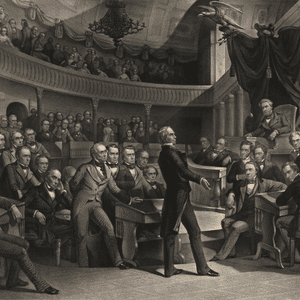
The basic proposal was that states with more than people should get more representatives, while states with lower populations would get fewer representations.
States with higher populations were happy with this arrangement. Still, smaller states felt it was unfair and wanted but equally much representation as the larger states would have.
The ramble convention was on the verge of collapse every bit this issue of representation was not existence resolved.
What is the Peachy Compromise?
The Great Compromise solved the issue of the representation of states by creating two houses. This is called a bicameral legislature.
The proposal was only narrowly accepted.
What did the proposal entail?
The number of representatives each land would go far the House of Representatives would exist proportional to that state's population. The number of members that each country could elect to the Senate would be 2 regardless of the state'south size.
In other words, larger states have more power in the Business firm of Representatives, but the largest and the smallest states have the same power in the Senate.
How does the Great Compromise work today?
As the most populous state in the Union, California has 53 representatives in the Business firm of Representatives. 7 smaller states – Alaska, Northward Dakota, South Dakota, Montana, Wyoming, Delaware, and Vermont – just have one representative.

With its nearly xl 1000000 people, California and Wyoming, with around 580,000 people, have 2 seats in the Senate. This number is the aforementioned with all states, regardless of size.
How is the number of members in the House of Representatives adamant?
The number of members of the Business firm of Representatives that each land gets is determined every 10 years through the demography, most recently conducted in 2020.
According to Article 1, every land must have at least ane representative, but at that place tin not exist more 1 representative for every 30,000 people.
The House of Representatives threatened to become too large as the country'due south population grew, and every ten years, Congress would make a police that stipulated the full number of representatives.
Since 1963, the number of representatives has been fixed at 435.
Issues with the Great Compromise in modern times
As the population has grown, the power of smaller states has become more and more disproportionate in the Senate. This means that modest states tin can demand more coin from the federal government in substitution for voting on specific bills. The number of votes that a bill needs to pass is 51, which is one more than than the number of senators.

The Keen Compromise was somewhat similar to the 3-Fifths Compromise. This counted iii/5 of enslaved people as part of a states' population for purposes of the number of congresspeople allowed in the House of Representatives. The similarity is that it sought to satisfy ii separate categories of states.
In the case of the Three-Fifths Compromise, information technology was slaveholding and not-slaveholding states.
The Great Compromise is written into Commodity I of the Constitution, which describes how the legislative co-operative functions.
The Nifty Compromise and the Electoral College
The Great Compromise also affects how the Electoral College works. Each state is assigned Electors based on the number of their House of Representatives and Senators combined.
California, for instance, has 55 electoral votes because they have 53 representatives and 2 senators.
Montana (and the other 6 states mentioned earlier with only 1 representative) has 3 electoral votes because they have 1 representative and two senators.
Presidential Campaigns

The number of representatives that a land has directly affects where presidential candidates choose to entrada in the country. Candidates will focus on states that could vote Republican or Democrat (swing states) and that take a significant electoral count. Florida, with its 29 electoral votes, is a good example.
It is through the legislative branch (Congress) and the executive co-operative (the President, who is elected past the Balloter College) that the Great Compromise affects the U.s. today.
Furnishings of the Great Compromise
The Great Compromise is why the United states of america has ii chambers in its legislature: the House of Representatives and the Senate. Collectively, these are referred to as the U.S. Congress.

Members of the House of Representatives are typically referred to every bit "Congresspeople" – "Congressman" or "Congresswoman," depending on gender – while members of the Senate are Senators.
The Peachy Compromise balances out concerns about representation based on population – although larger states have more than power in the House of Representatives, all states have the same amount of ability in the Senate.
All this ensures that every state is relevant when making laws that apply to the entire country. An example is that California can't overpower Wyoming because, although they have more than Representatives in the House, they each have the same number of senators in the Senate.
Watch the following video to find out more nigh the Not bad Compromise:
Source: https://constitutionus.com/constitution/the-great-compromise/
0 Response to "What Did the Connecticut Compromise Help to Establish"
Postar um comentário