Is Pan Am Using the Mountain Division Again
Boston And Maine Railroad: "Route Of The Infinitesimal Man"
Last revised: February xix, 2022
By: Adam Burns
The largest of New England's railroads, the Boston & Maine is synonymous with the territory and for over 180 years has served information technology well.
Today's B&M is much different than the 1 of mid-century; what'southward left of its historic network is operated by Pan Am Railways, previously known as Guilford Runway System.
During the company's superlative it maintained more than ii,000 miles, snaking north and w away from its abode city of Boston.
In addition, the road continued with all of the of import regional systems including the New Haven, Maine Fundamental, Boston & Albany (New York Primal), Central Vermont, and Rutland.
The B&G's decline began like most of its neighbors, during the immediate mail service-World State of war II menstruation as a shrinking traffic base and saturation of rails lines meant only the strongest would survive.
The company managed to weather these turbulent times although new ownership nether Guilford saw nearly one-half its network abandoned after the 1980s. Today, a picayune over one,000 miles of the original B&Chiliad property continues to acquit on nether the Pan Am banner.
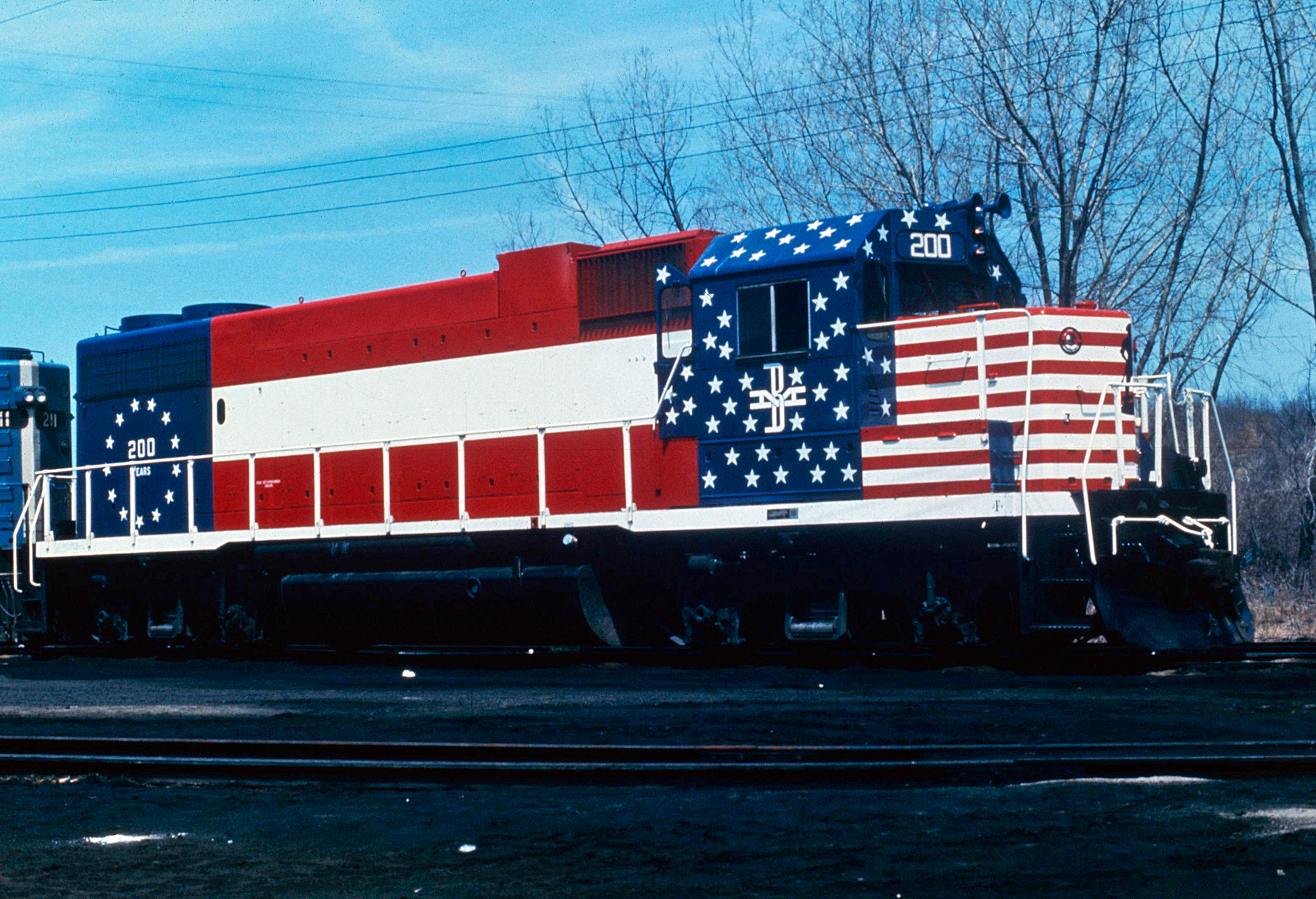 Boston & Maine GP38-2 #200 is seen hither dressed in its Bicentennial livery at Mechanicville, New York on Apr 17, 1975. 1000. Berisso photo. American-Rail.com collection.
A Brief History Of The Boston & Maine
The Boston & Maine's immediate corporate history began on June 27, 1835 with its formal chartering in New Hampshire with intentions of linking its namesake city with Portland, Maine.
Perhaps most interesting is that the original company was quite small and much of its future expansion was the outcome of acquisition, which sometimes resulted in duplicate routes serving the same regions.
The B&G opened its first segment in 1840. Nearly ii years later it merged with the Maine, New Hampshire & Massachusetts and Boston & Portland on January one, 1842 while retaining the Boston & Maine name.
On February 23, 1843 it had opened service between Exeter, New Hampshire and South Berwick, Maine where a connexion was established with the Portland, Saco & Portsmouth.
This organisation offered rail service from Due north Berwick into Portland, a city the B&M was attempting to serve. The New England of this era was riddled with railroads either under structure or in the planning stages. A B&M rival, the Eastern Railroad, was also working on a route into Portland.
In a rare case of cooperation the two jointly agreed to lease the PS&P. The original B&Thou line became its "Inside Gateway" to Boston operating via Dover, Haverhill, and Lawrence while the Eastern skirted the Atlantic coastline via Portsmouth, Newburyport, and Salem.
The Eastern was originally chartered on Apr 14, 1836 and began construction over a year later in August of 1837. Information technology worked its way northward out of Boston and reached the New Hampshire state line on November ix, 1840.
The Eastern remained a rival of the B&K throughout its existence until the latter formally leased the old on December 23, 1883.
It would eventually purchase the system outright in the jump of 1890. Past then, the Boston & Maine was fast becoming the dominant railroad in the region.
As Mike Schafer notes in his volume, "Classic American Railroads," until the late 19th century the B&M had remained a relatively small-scale, obscure performance with a network of only around 200 miles.
Its substantial growth occurred later on the Civil State of war post-obit the manufacturing base which sprang up across New England. This explosion of new industry fueled the construction of numerous railroads, several of which the B&M would later control.
 Boston & Maine Railroad logo. Author's work.
Its notable additions at this fourth dimension included:
- Boston & Lowell (Originally chartered in 1830 it connected its namesake cities and stretched as far west equally Keene, New Hampshire. It went on to form part of the B&M'due south Southern Division.)
- Worcester, Nashua & Portland (Created in 1883 through the merger of two predecessors, the line linked Worcester, Massachusetts with Portland, Maine. Information technology provided the B&1000 with a third primary line to Portland and became superfluous, slowly abandoned after 1932.)
- Northern Railroad (Running from Agree to White River Junction, Vermont it opened for service in 1847 and was acquired by the B&50 in 1884.)
- Concord & Montreal (Information technology began structure in 1846 as the Boston, Concord & Montreal eventually linking Hold with Wells River, Vermont. It came under B&L control so B&M until being spun-off forming the Hold & Montreal. The B&G reacquired the road in 1895.)
- Fitchburg Railroad (This organisation was leased past the B&Thou on July 1, 1900 providing it admission across Massachusetts and the important Hoosac Tunnel which finally tackled the previously impenetrable Dark-green Mountains. Information technology too offered western connections at Albany, New York and Rotterdam Junction.)
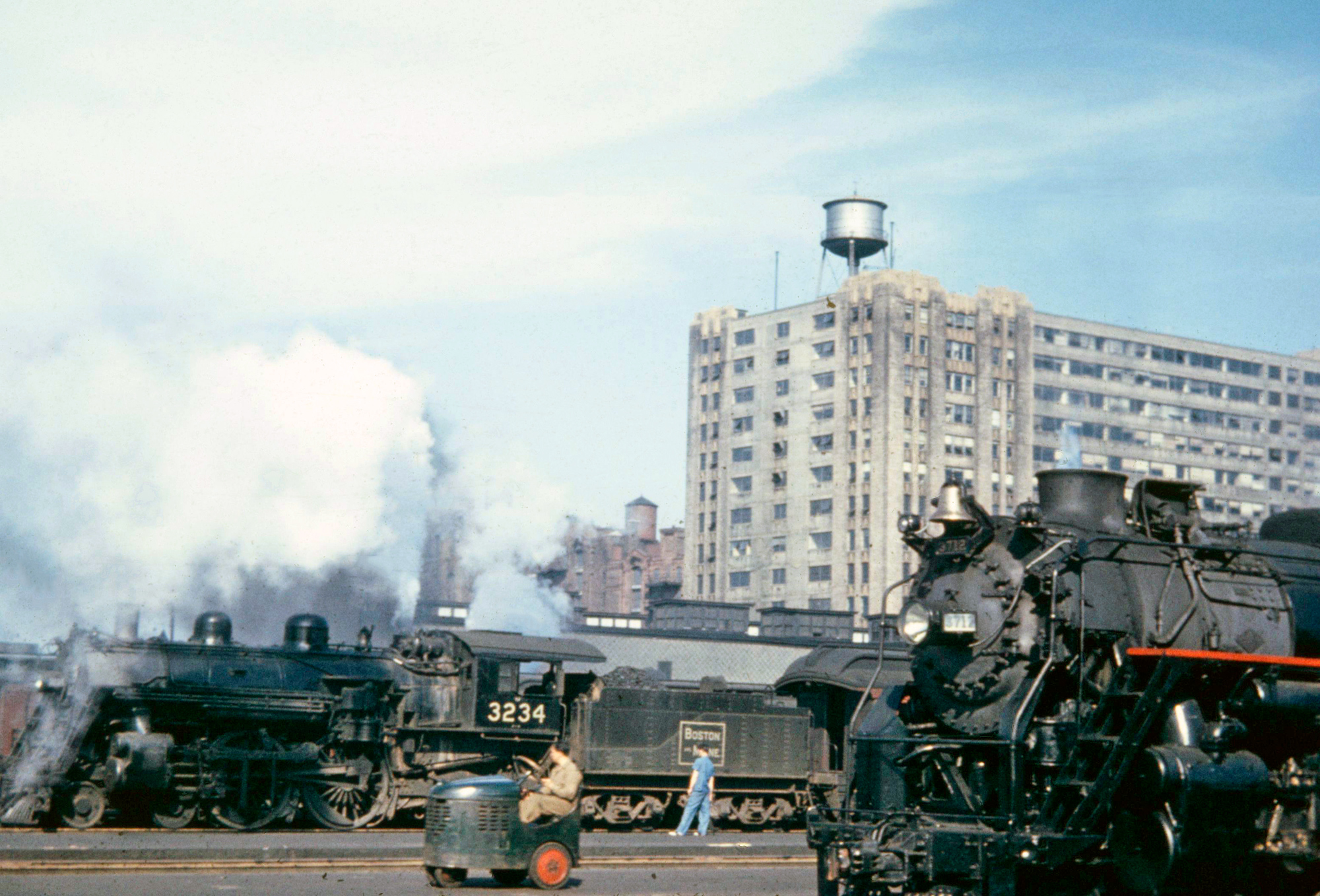 A busy scene at Boston's North Station during the 1950's. In the foreground is Boston & Maine 4-6-two #3712 (P-four) while in the groundwork can be seen 4-4-ii #3234 (J-1e). Writer'due south collection.
Through these mergers the B&M grew into a system of over 2,300 miles which reached the markets of northeastern Vermont and northern New Hampshire, most of Massachusetts and western New York. Co-ordinate to the Boston & Maine Historical Gild its peak workforce included roughly 28,000 individuals.
The railroad operated major yards in Boston, East Deerfield, Rigby, and Mechanicville while its primary maintenance facilities were located at Northward Billerica, Massachusetts and Concord, New Hampshire.
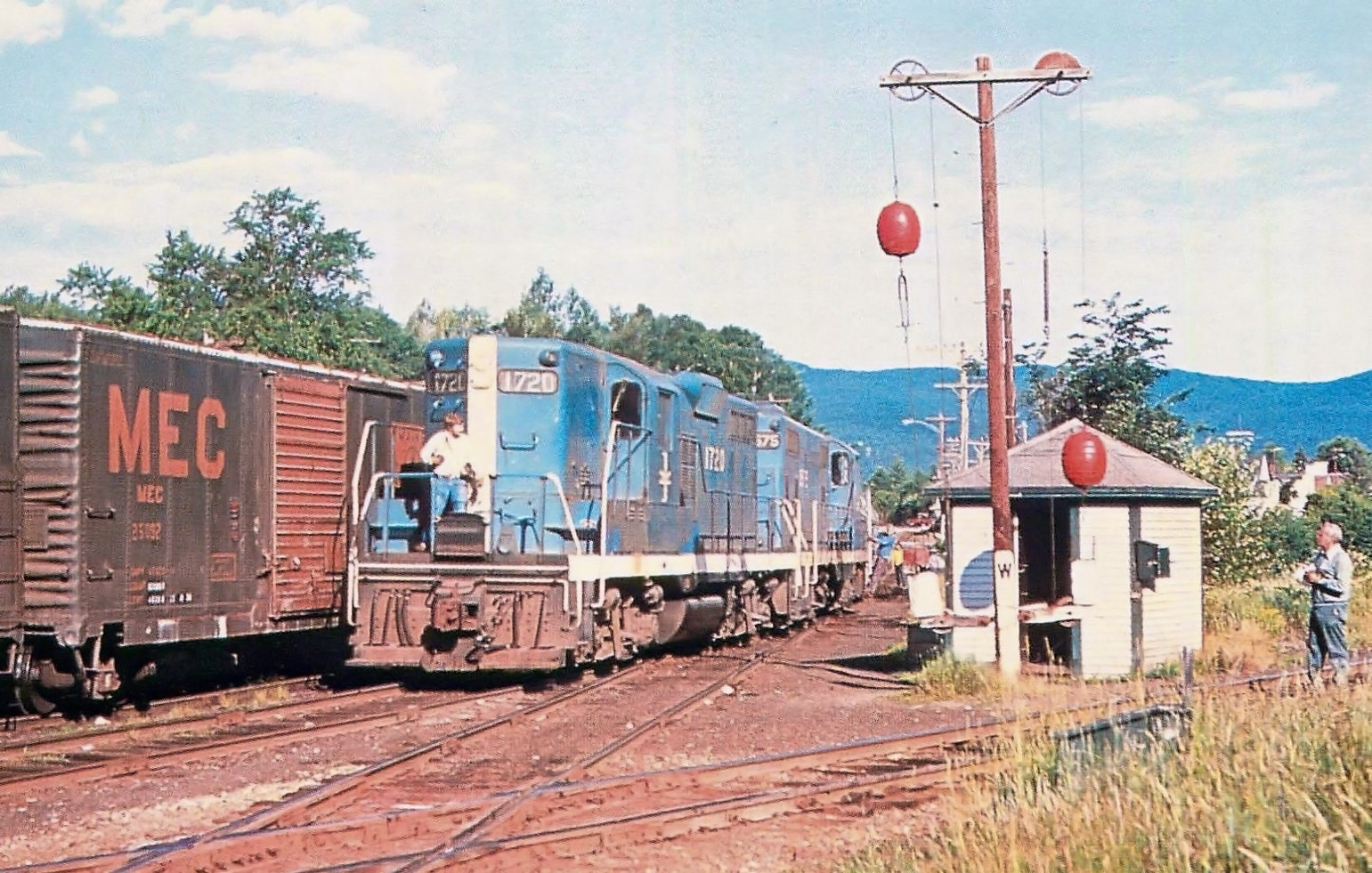 Boston & Maine GP9 #1720 and GP7 #1575, bound for Berlin, take a clear "High Ball" as they prepare out cars for the Maine Central at Whitefield, New Hampshire on July 22, 1976. This early on blazon of signaling system is where the term "high ball" originated. Ronald Johnson photo.
Its main line to eastern New York was its most of import freight road since it provided interchanges with the Delaware & Hudson and Erie/Erie Lackawanna.
It also worked with other carriers in the region such as the Rutland, Maine Fundamental, and Key Vermont, to provide efficient service across New England.
During the B&M's superlative years, before the Great Depression, information technology moved a substantial diverseness of freight from dedicated milk trains and piece of furniture to coal and textiles. Information technology also enjoyed a healthy less-than-carload (LCL) business organization.
Since the railroad'southward network was full-bodied within only a few states it offered limited long-distance passenger services to accompanying its expansive commuter operations.
Its well-nigh known trains included:
- Ambassador (Boston - Montreal),Alouette (Boston - Montreal)
- Green Mountain Flyer (Boston to Montreal via Canadian National and Rutland)
- The seasonalEast Wind (Washington - Bangor)
- The lightweight streamlinerFlight Yankee ,operated in conjunction with the Maine Central, a nearly identical sister to the famous Burlington'sZephyr 9900
As you can run into, many of these services were operated in tandem with other carriers. Aside from theEast Wind, theGull covered the greatest territory; a passenger taking this railroad train its entire length boarded at Boston and de-trained at Halifax, Nova Scotia.
It was handled by the B&M, Maine Central, Canadian National, and Canadian Pacific surviving until 1960. After the depression it rebounded during the hectic World State of war II catamenia only then again declined after this time.
Notable Boston & Maine Predecessors
Boston & Lowell: The B&L was chartered on June 5, 1830, opening for service betwixt its namesake cities (26 miles) in 1835.
From the very start the road handled a broad variety of freight and too enjoyed a healthy passenger business concern. It somewhen opened service to Keene, New Hampshire via Milford and Nashua while branches reached Salem, Hold, and Ayer Junction.
The railroad spent many years battling rival Boston & Maine before succumbing when the latter leased it on Apr one, 1887.
It went to grade part of the B&M's Southern Segmentation and always remained a relatively busy corridor throughout the years. Today, much of its original trackage is operated every bit part of Pan Am Railways.
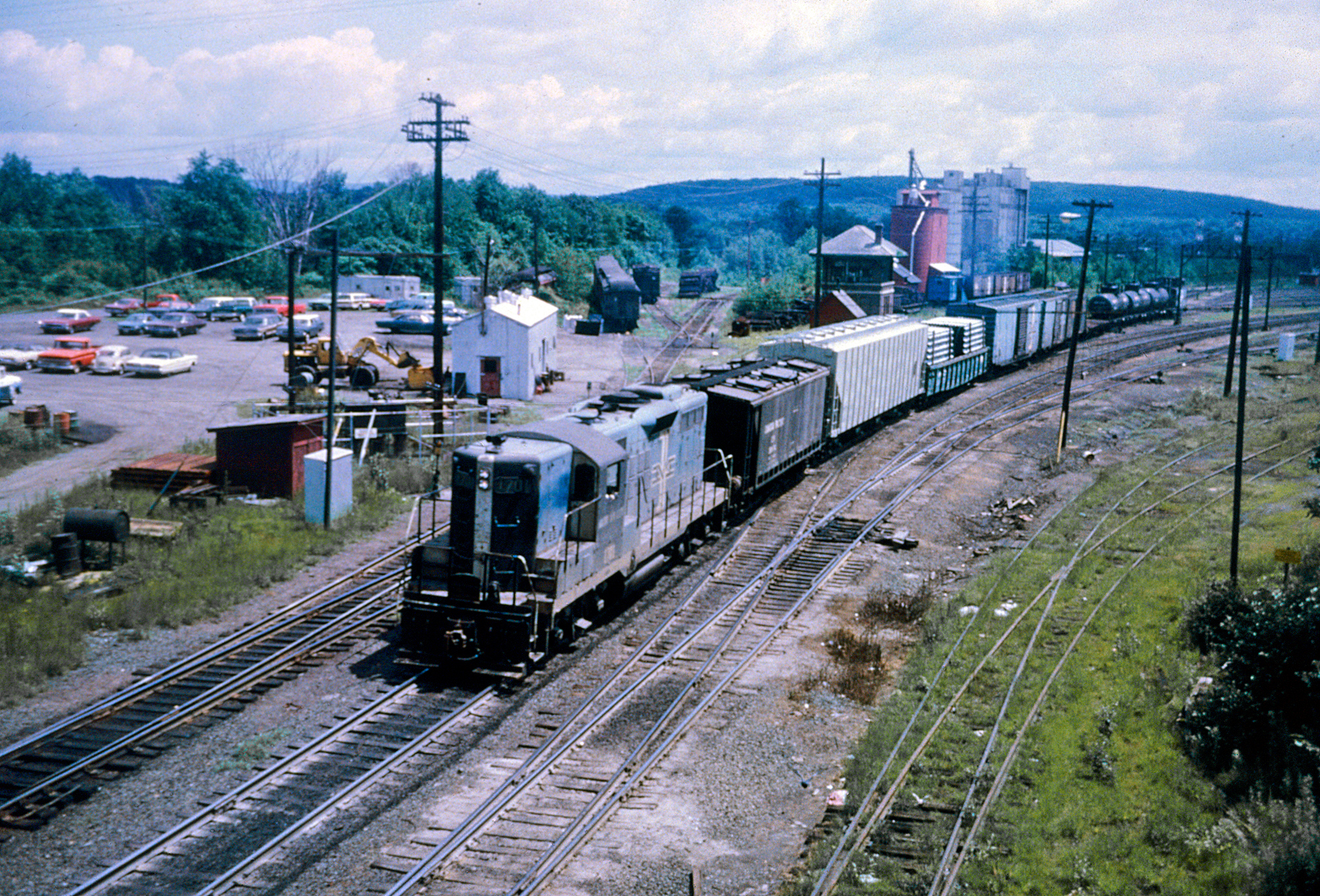 Boston & Maine GP9 #1701 leads a short train westward out of the g at Due east Deerfield, Massachusetts on July 28, 1972. Note the interlocking tower in the groundwork, which controlled movements at this location. Thanks to McClelland Farm Road overpass at the western finish of the yard, this was a famous spot on the B&M for photographs. American-Rails.com collection.
Concord & Montreal:The C&Chiliad began every bit the Boston, Agree & Montreal incorporated in 1844.
Its first segment opened between Concord and Tilton, New Hampshire on May 22, 1848 and connected snaking northward until reaching Plymouth on June 21, 1850 (via Laconia and Meredith). Finally, on May ten, 1853 rails reached Wells River, Vermont on May ten, 1853.
The Boston & Maine starting time acquired control of the BC&M in 1887 simply soon spun-off the railroad which went on to form the Concur & Montreal on July 24, 1889.
The C&Thou was a consolidation of the BC&One thousand and Concord Railroad remaining independent for only a few additional years before it was once again leased by the B&M on April 1, 1895.
The addition of this system provided the railroad with a majority stake in New Hampshire's railroads providing service to all of its major cities such as Bellows Falls, Wells River, Hold, Nashua, and Manchester.
Fitchburg Railroad: The about important component of the B&M was the Fitchburg Railroad, leased on July 1, 1900. It provided access across Massachusetts to important interchange points in New York at Albany and Rotterdam Junction.
The Fitchburg was incorporated on March three, 1842, opening between Boston and Fitchburg on March 5, 1845. Information technology was a substantial operation prior to the B&M takeover connecting Bellows Falls and Worcester in addition to eastern New York.
Its most of import infrastructure project was the completion of the 4.75-mile Hoosac Tunnel in western Massachusetts which finally tackled the formidable Green Mountains.
After the B&M takeover the property became known as its Fitchburg Partitioning. Mike Schafer notes in his book that the route still handled more than a dozen scheduled freights daily afterwards World War Two and today remains a vital component of Pan Am.
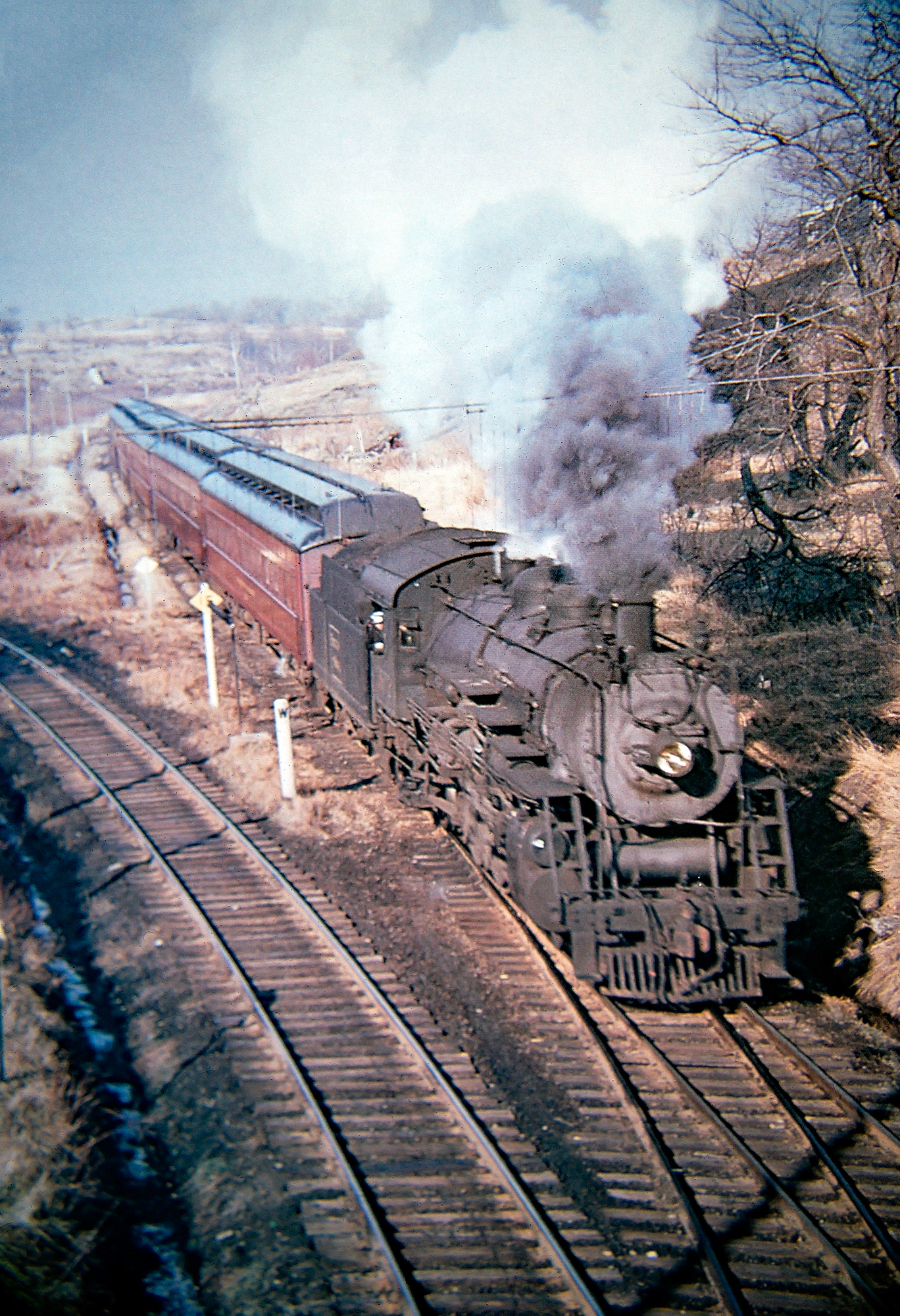 Boston & Maine iv-6-2 #3692 arrives in Marblehead, Massachusetts with an outbound, Boston - Marblehead commuter run on Feb ii, 1956. American-Track.com collection.
Northern Railroad: A later subsidiary of the B&L, acquired in 1884, it operated from Concur to White River Junction, Vermont. It was kickoff chartered in 1844 by the New Hampshire land legislature to "construct a line running from Agree to some indicate along the Connecticut River."
Construction of the Northern proceeded speedily; on December 28, 1846 the line was open to Franklin and by November 17, 1847 reached Lebanese republic.
After a few months of boosted work the span beyond the Connecticut River was completed and the route finished to White River Junction. In total, the Northern Railroad stretched nearly 70 miles.
The company's sole branch was as well acquired at this time when information technology leased, and somewhen took control, of the pocket-sized Franklin & Bristol in 1849. This picayune system ran from a connection at Franklin to Bristol, New Hampshire.
According to Bruce Heald'south book, "A History Of The Boston & Maine Railroad," on July 24, 1889 the New Hampshire Full general Court gave Boston & Maine permission to formally charter the Northern.
The route prospered until the postwar period; the last passenger train ran on January 3, 1965. It survived intact until the Guilford era when 59 miles was abandoned between Boscawen and Lebanon in 1991.
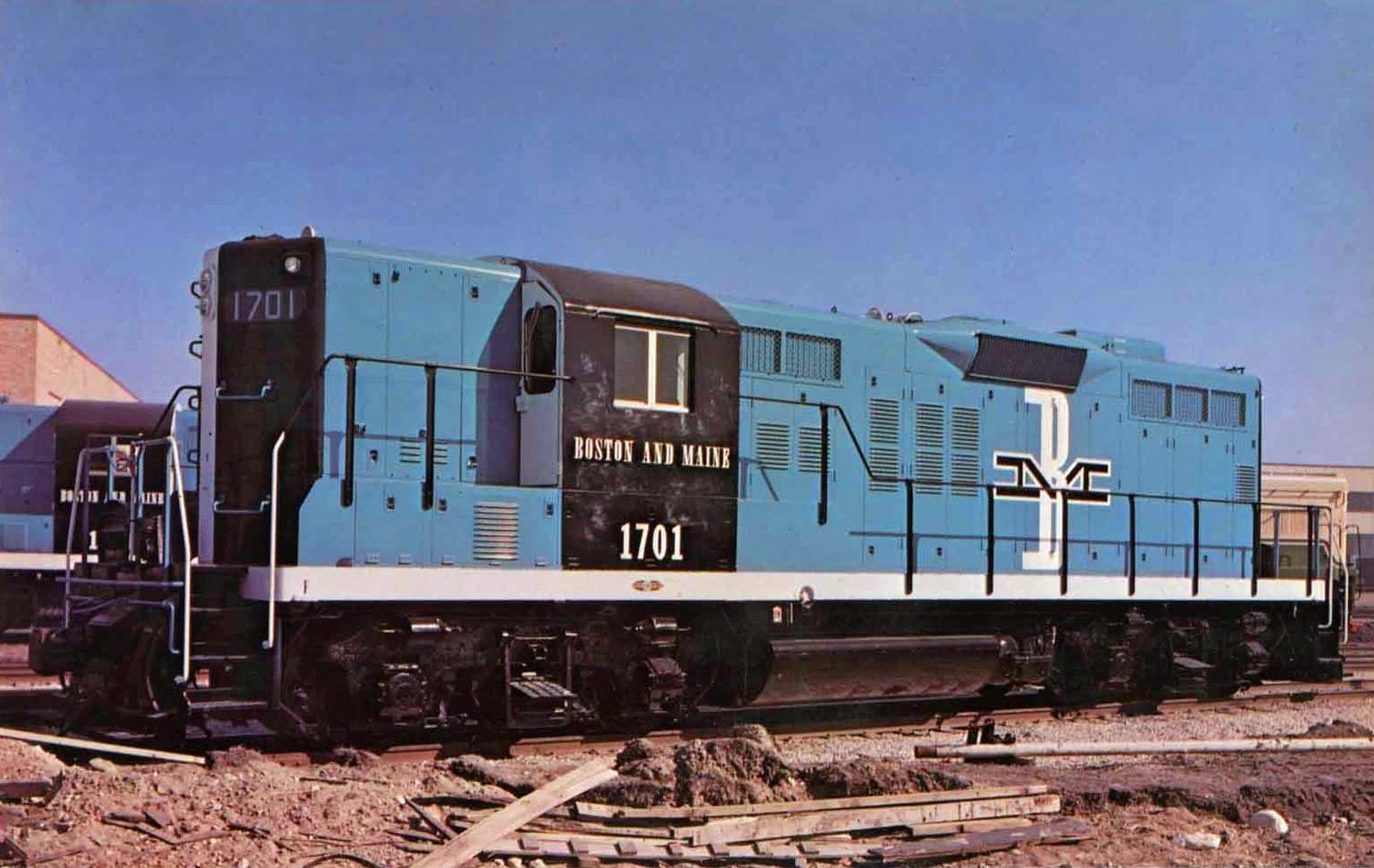 An Electro-Motive builder's photo featuring freshly-outshopped Boston & Maine GP9 #1701 in early on 1957.
Worcester, Nashua & Portland: The WN&P was an 1883 formation through the merger of the Worcester & Nashua (formed in 1845 it opened between Worcester and Nashua past late 1848) and Nashua & Rochester (created in 1847 to connect its namesake cities).
The Due north&R was leased by the W&Due north in 1874, and the ii, forth with the Portland & Rochester, merged to form the Worcester, Nashua & Rochester in 1883. This new organisation provided for through service betwixt Worcester and Portland.
In 1886, the B&G acquired control of the WN&R and renamed information technology as the Worcester, Nashua & Portland Sectionalization (WN&P Division) with a total length of 146.nine miles.
The B&Thousand now controlled three routes betwixt Portland and Massachusetts, which carried enough concern until World War I to maintain all three.
At this time the first reductions took identify. Afterwards the Great Depression hit the WN&P was looked upon as redundant.
The beginning abandonments took place in 1932 when sections in New Hampshire were let go. By the 1950s, only ii big sections remained; westward of Portland and between Worcester and Hollis. By the 1980s nearly of the the one-time WN&P was gone.
The postwar period proved especially problematic for the B&K. Its traffic base of operations continued to erode every bit manufacturing, and business in full general, either closed its doors or switched to trucks. The region'south curt-haul freight business meant that area railroads were especially susceptible to highways.
The B&M'due south issues were magnified past poor management under Patrick McGinnis during this fourth dimension, who also headed the New Haven. He was a poor railroader and both companies suffered every bit a issue.
System Map (1946)
The B&Yard took on a stance of deferred maintenance and its infrastructure roughshod apart during the 1960s; coupled with failing traffic the railroad entered receivership on February 1, 1970.
Miraculously, information technology was able to avert inclusion into the Consolidated Rail Corporation (Conrail), which began operations on April 1, 1976.
Boston & Maine'southward Many Passenger Trains
Alouette/Blood-red Fly: (Boston - Montreal)
Ambassador/New Englander: (Boston - Montreal)
Bar Harbor Express: (Washington - Ellsworth, Maine)
Cheshire: (Boston - White River Junction)
Day White Mountains: (New York - Berlin, New Hampshire)
East Wind: (Washington - Bangor, Maine)
Flying Yankee: (Boston - Bangor)
Green Mount Flyer: (Boston - Montreal)
TheGull: (Boston - Halifax, Nova Scotia)
Kennebec: (Boston - Portland - Bangor)
Minute Man: (Boston - Troy, New York)
Montrealer/Washingtonian: (Washington - New York - Montreal)
Mountaineer: (Boston - Littleton/Bethlehem, New Hampshire)
Pino Tree: (Boston - Portland - Bangor)
State of Maine: (New York - Portland)
Under the direction of new president Alan G. Dustin the railroad was rescued from the brink through aggressive management, marketing, and audio railroading.
By the early on 1980s the B&Chiliad had erased its deficits, an incredible feat considering the state of the industry in this region at the time. Now a successful functioning it caught the eye of those with money.
Diesel Locomotive Roster
The American Locomotive Company
| Model Type | Route Number | Date Built | Quantity |
|---|---|---|---|
| S5 | 860-865 | 1954 | 6 |
| HH600 | 1101 | 1938 | 1 |
| HH660 | 1162 | 1939 | 1 |
| S1 | 1163-1172 | 1944-1949 | x |
| S3 | 1173-1188 | 1950-1952 | 16 |
| S2 | 1260-1265 | 1944-1945 | 6 |
| S4 | 1266-1273 | 1950 | eight |
| RS2 | 1501-1504, 1530-1534 | 1949 | 9 |
| RS3 | 1505-1519, 1535-1545 | 1952-1954 | 26 |
Electro-Motive Corporation/Electro-Motive Division
| Model Type | Road Number | Engagement Built | Quantity |
|---|---|---|---|
| GP38-2 | 201-212 | 1973 | 12 |
| GP40-2 | 300-317 | 1977 | 18 |
| SW8 | 800-807 | 1953 | 8 |
| SC | 1103-1108 | 1936-1938 | 6 |
| SW1 | 1109-1132 | 1939-1953 | 24 |
| NW2 | 1200-1213 | 1941-1949 | 14 |
| SW9 | 1220-1231 | 1952-1953 | 12 |
| BL2 | 1550-1553 | 1948 | 4 |
| GP7 | 1555-1577 | 1950-1953 | 23 |
| GP9 | 1700-1749 | 1957 | 50 |
| GP18 | 1750-1755 | 1961 | half-dozen |
| E7A | 3800-3820 | 1945-1949 | 21 |
| E8A | 3821 | 1950 | ane |
| FTA | 4200A-4223A | 1943-1944 | 24 |
| FTB | 4200B-4223B | 1943-1944 | 24 |
| F2A | 4250-4264, 4224A-4226A | 1946 | 18 |
| F2B | 4224B-4226B | 1946 | 3 |
| F3A | 4227A-4228A | 1948 | 2 |
| F3B | 4227B-4228B | 1948 | two |
| F7A | 4265-4268 | 1949 | iv |
| F7B | 4265B-4268B | 1950 | iv |
| "Flying Yankee" Trainset | 6000 | 1935 | 1 |
Fairbanks-Morse
| Model Blazon | Road Number | Date Built | Quantity |
|---|---|---|---|
| P12-42 | one-ii | 1957-1958 | 2 |
General Electric
| Model Type | Road Number | Engagement Built | Quantity |
|---|---|---|---|
| 44-Tonner | 110-119 | 1940-1948 | x |
| U33B (Ex-Penn Central) | 190-192 | 1968 | 3 |
Steam Locomotive Roster
| Grade | Type | Wheel Arrangement |
|---|---|---|
| A-xiii Through A-47 | American | iv-four-0 |
| B (Diverse) | Mogul | 2-6-0 |
| C-3 Through C-21 | Ten-Wheeler | 4-6-0 |
| D-2 | Saddle Tank | 0-four-4T |
| E-1-a/b | Saddle Tank | ii-6-4T |
| F | Switcher | 0-4-0/0-4-0T |
| G | Switcher | 0-half dozen-0 |
| H-1 Through H-3 | Switcher | 0-8-0 |
| J-i | Atlantic | 4-4-2 |
| K | Consolidation | 2-8-0 |
| Fifty-1 | Twelve-Wheeler | four-8-0 |
| Yard-1 | Articulated | two-6-6-two |
| K-2 | Articulated | 0-8-8-0 |
| N-one | Mikado | ii-viii-2 |
| P-1 Through P-five | Pacific | four-six-two |
| R-1 | Mount | 4-eight-two |
| T-ane | Berkshire | ii-viii-4 |
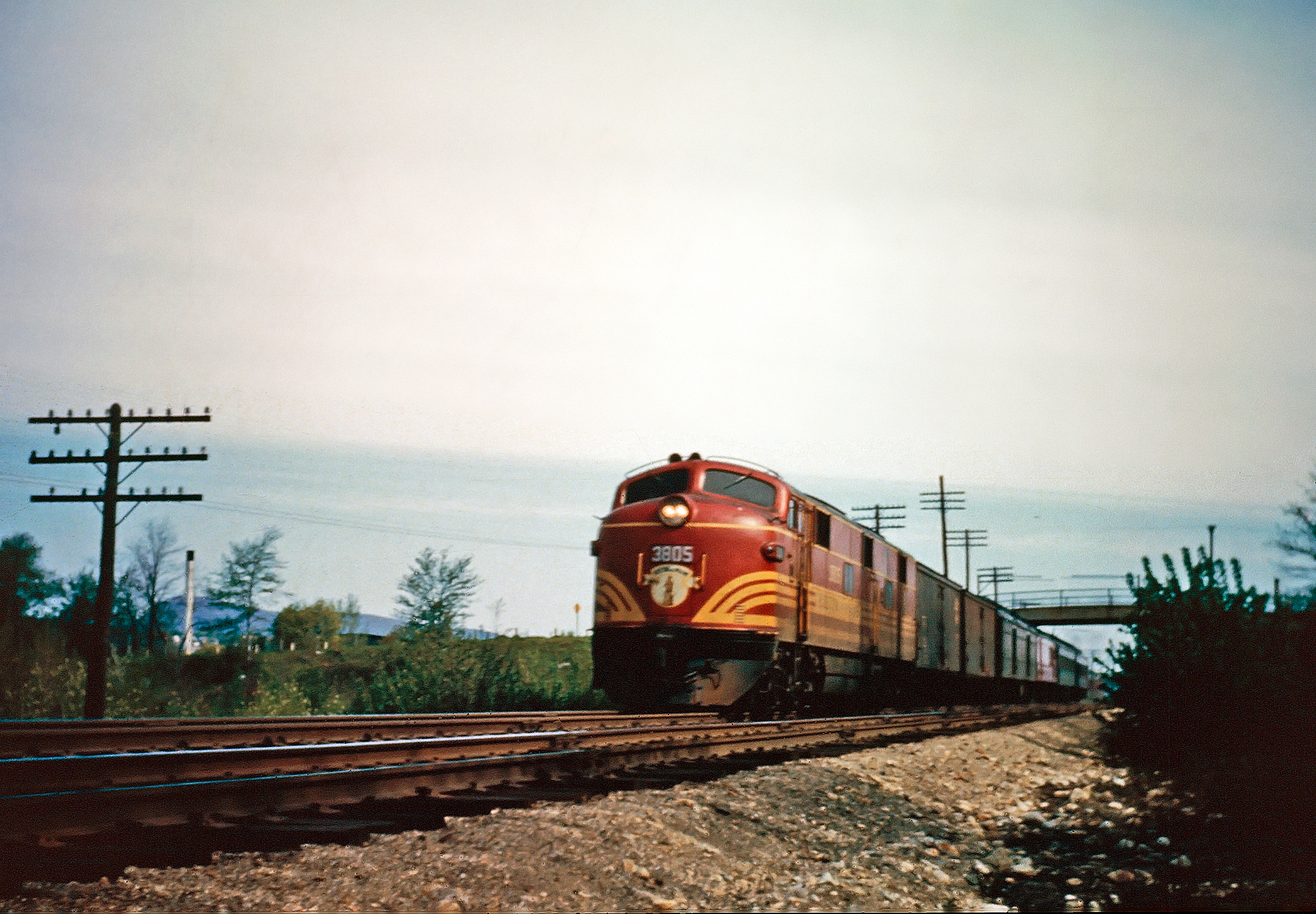 Boston & Maine E7A #3805 leads a Greenfield-Springfield train southbound through Chicopee, Massachusetts on May 20, 1956. American-Rail.com collection.
The B&M was purchased by Timothy Mellon, founder of Guilford Transportation Industries, on June 30, 1983 for a price of $24 1000000.
Mellon's new railroad system included a black livery with bright orange trim and while sub-lettering was applied to the owning railroad's equipment (a do that continues today under Pan Am).
In addition to the B&M, Mellon, acquired the Maine Central, Springfield Terminal (an MEC subsidiary), and Delaware Hudson although the latter system was later sold.
His leadership has also been questioned by historians equally hundreds of miles of the B&M's network was abandoned during the 1980s and 1990s, many of which were nonetheless considered viable routes.
In 2006, new-parent Pan Am Systems renamed Guilford every bit Pan Am Railways. Information technology currently operates four principal B&M routes; Boston - Portland, Boston - Concord, Boston - Rotterdam Junction and Springfield - White River Junction. Today the Boston and Maine Railroad is still officially on the books although it survives at present more often than not in name but.
- Home ›
- Fallen Flags ›
- Boston & Maine
Source: https://www.american-rails.com/bm.html
0 Response to "Is Pan Am Using the Mountain Division Again"
Postar um comentário