Gas Mask British Not Amused Plague Doctor Art 1080

Paul Fürst, engraving, c. 1721, of a plague doctor of Marseilles (introduced as 'Dr Beaky of Rome'). His nose-example is filled with herbal textile to keep off the plague.[1]
The wear worn past plague doctors was intended to protect them from airborne diseases during outbreaks of the Bubonic Plague in Europe.[2] It is often seen equally a symbol of death and disease.[3] All the same, the costume was worn by a insufficiently pocket-sized number of late Renaissance and early on mod physicians studying and treating plague patients.[4]
Description [edit]
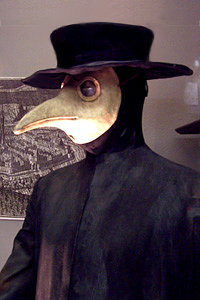
Plague medico outfit from Germany (17th century)
The typical costume consists of an talocrural joint-length overcoat and a bird-like nib mask, ofttimes filled with sweetness or stiff-smelling substances (commonly lavender), along with gloves, boots, a broad-brimmed hat, and an outer over-clothing garment.[5]
The typical mask had glass openings for the eyes and a curved neb shaped like a bird'southward nib with straps that held the beak in front of the doctor'southward nose.[6] The mask had two small nose holes and was a type of respirator which contained aromatic items.[7] The neb could agree dried flowers (including roses and carnations), herbs (including lavender and peppermint), camphor, or a vinegar sponge,[viii] [9] as well as juniper drupe, ambergris, cloves, labdanum, myrrh, and storax.[x] The purpose of the mask was to keep away bad smells, known equally miasma, which were thought to exist the principal cause of the disease.[11] Doctors believed the herbs would counter the "evil" smells of the plague and foreclose them from becoming infected.[12]
The wide-brimmed leather hat indicated their profession,[thirteen] [14] and they used wooden canes in order to betoken out areas needing attending and to examine patients without touching them.[fifteen] The canes were also used to continue people away[16] [17] and to remove clothing from plague victims without having to touch on them.[18]
History [edit]
The verbal origins of the costume are unclear, as most depictions come up from satirical writings and political cartoons.[19] The beaked plague doctor inspired costumes in italian theater as a symbol of full general horror and expiry, though some historians insist that the plague doctor was originally fictional and later on inspired the real plague doctors later.[xx] Depictions of the beaked plague physician rose in response to superstition and fear about the unknown source of the plague.[21] Often, these plague doctors were the concluding thing a patient would run across before decease; therefore, the doctors were seen as a foreboding to death.
The garments were first mentioned by md to King Louis XIII of France, Charles de L'Orme, who wrote in a 1619 plague outbreak in Paris that he developed an outfit made of Moroccan goat leather, including boots, breeches, a long coat, hat and gloves[22] [23] modeled after a soldier's canvas gown which went from the cervix to the talocrural joint.[24] [25] [26] The garment was impregnated with similar fragrant items as the mask.[27] L'Orme wrote that the mask had a "nose half a foot long, shaped like a beak, filled with perfume with only 2 holes, one on each side near the nostrils, but that can suffice to breathe and to acquit along with the air i breathes the impression of the drugs enclosed farther along in the nib".[28]
The Genevese physician Jean-Jacques Manget, in his 1721 piece of work Treatise on the Plague written just afterwards the Great Plague of Marseille, describes the costume worn by plague doctors at Nijmegen in 1636–1637. The costume forms the frontispiece of Manget's 1721 piece of work.[29] Their robes, leggings, hats, and gloves were besides made of Kingdom of morocco leather.[xxx] This costume was too worn by plague doctors during the Plague of 1656, which killed 145,000 people in Rome and 300,000 in Naples.[32]
Carnival [edit]

A beaked Venetian carnival mask bearing a picture of a plague doctor, and the inscription Doctor della Peste ("Plague doctor") beneath the right centre
The costume is also associated with a commedia dell'arte character chosen Il Dr. della Peste (lit: The Plague Doctor), who wears a distinctive plague dr.'s mask.[33] The Venetian mask was normally white, consisting of a hollow pecker and circular heart-holes covered with clear glass, and is one of the distinctive masks worn during the Carnival of Venice.[34]
See also [edit]
- Gas mask – Protection from inhaling airborne pollutants and toxic gases
- Hazmat arrange – Protective suit against chemical, bacteriological, and nuclear risks
- Medical gown – Blazon of personal protective equipment worn by medical professionals
- NBC suit – Type of military personal protective equipment
- N95 respirator – Particulate respirator coming together the N95 standard
References [edit]
Footnotes [edit]
- ^ Füssli'south image is reproduced and discussed in Robert Fletcher, A tragedy of the Nifty Plague of Milan in 1630 (Baltimore: The Lord Baltimore Printing, 1898), p. xvi–17.
- ^
- Pommerville (Body Systems), p. 15
- Bauer, p. 145
- Byfield, p. 26
- Glaser, pp. 33-34
- ^ Andrew Whalen On 3/xix/20 at i:31 PM EDT (2020-03-xix). "Are surgical masks the new plague masks? A history of the not-always-helpful ways we've reacted to pandemics". Newsweek . Retrieved 2021-03-09 .
- ^ Black, Winston; May 2020, All About History 19 (xix May 2020). "Plague doctors: Separating medical myths from facts". livescience.com . Retrieved 2021-03-09 .
- ^ * Pommerville (Body Systems), p. 15
- Bauer, p. 145
- Byfield, p. 26
- Glaser, pp. 33-34
- ^ Ellis, p. 202
- ^ *Fourth dimension-Life Books, pp. 140, 158
- Dolan, p. 139
- Ellis, p. 202
- Paton
- Martin, p. 121
- Sherman, p. 162
- Turner, p. 180
- Mentzel, p. 86
- Glaser, p. 36
- Hall, p. 67
- Infectious Diseases Gild of America, Volume 11, p. 819
- Grolier, p. 700
- ^ O'Donnell, p. 135
- ^ Stuart, p. 15
- ^ Byrne 2006, p. 170. sfn fault: no target: CITEREFByrne2006 (assist)
- ^ "Plagues of the Past". Science in the News. 2014-12-31. Retrieved 2021-03-09 .
- ^ Irvine Loudon, Western Medicine: An Illustrated History (Oxford, 2001), p. 189.
- ^ * Pommerville (Body Systems), p. 15
- Bauer, p. 145
- Byfield, p. 26
- Glaser, pp. 33-34
- ^ Center for Advanced Study in Theatre Arts, p. 83
- ^ "Imagery From the History of Medicine". fine art-bin.com . Retrieved 2021-03-09 .
- ^ Association, American Medical (1900). JAMA: The Periodical of the American Medical Association. American Medical Association.
- ^ Byrne 2008, p. 505. sfn error: no target: CITEREFByrne2008 (help)
- ^ Pommerville, p. 9
- ^ "17th-century Plague Doctors Were the Stuff of Nightmares". HowStuffWorks. 2020-02-12. Retrieved 2021-03-09 .
- ^ Black, Winston; May 2020, All Nearly History 19 (xix May 2020). "Plague doctors: Separating medical myths from facts". livescience.com . Retrieved 2021-03-09 .
- ^ Mussap, J.C. (2019). https://onlinelibrary.wiley.com/doi/abs/ten.1111/imj.14285 "The Plague Doctor of Venice". Internal Medicine Periodical. 49 (five): 673. doi:x.1111/imj.14285. PMID 31083805. S2CID 153311347 – via Google Scolar.
- ^ Blackness, Winston; May 2020, All Well-nigh History 19 (nineteen May 2020). "Plague doctors: Separating medical myths from facts". livescience.com . Retrieved 2021-03-09 .
- ^ Timbs, p. 360
- ^ Boeckl, p. 15
- ^ Carmichael, A.1000. (2009), "Plague, Historical", in Schaechter, Moselio (ed.), Encyclopedia of Microbiology (3rd ed.), Elsevier, pp. 58–72, doi:x.1016/B978-012373944-5.00311-iv, ISBN9780123739445
- ^ Iqbal Akhtar Khan (May 2004). "Plague: the dreadful visitation occupying the human listen for centuries". Transactions of the Royal Society of Tropical Medicine and Hygiene. 98 (5): 270–277. doi:x.1016/S0035-9203(03)00059-2. PMID 15109549.
Charles Delorme (1584—1678), personal md to Rex Louis Thirteen, was credited with introducing special protective clothing for plague doctors during the epidemic in Marseilles. It consisted of a bill-similar mask supplied with aromatic substance, presumed to act every bit filter against the odour emanating from the patients, and a loose gown covering the normal vesture. On occasions, a drifting fragrance such every bit camphor was used.
- ^ Time-Life Books, p. 158 Bill Doctor: during the Black Plague, a medical man who wore a bird mask to protect himself confronting infection. Black plague definition: In 14th-century Europe, the victims of the "blackness plague" had bleeding beneath the skin (subcutaneous hemorrhage) which made darkened ("blackened") their bodies. Blackness plague tin can lead to "black death" characterized by gangrene of the fingers, toes, and nose. Black plague is caused by a bacterium (Yersinia pestis) which is transmitted to humans from infected rats by the oriental rat flea.. medterm.com
- ^ Vidal, Pierre; Tibayrenc, Myrtille; Gonzalez, Jean-Paul (2007). "Affiliate 40: Infectious illness and arts". In Tibayrenc, Michel (ed.). Encyclopedia of Infectious Diseases: Modern Methodologies. John Wiley & Sons. p. 680. ISBN9780470114193.
- ^ Manget, p. 3
- ^ Timbs, p. 360
- ^ Christine M. Boeckl, Images of plague and pestilence: iconography and iconology (Truman State University Press, 2000), pp. fifteen, 27.
- ^ Killinger, p. 95
- ^ Carnevale
Works cited [edit]
- Bauer, South. Wise, The Story of the World Activity Book 2: The Middle Ages : From the Autumn of Rome to the Rise of the Renaissance, Peace Colina Press, 2003, ISBN 0-9714129-4-four
- Boeckl, Christine Thousand., Images of plague and pestilence: iconography and iconology, Truman Country Univ Press, 2000, ISBN 0-943549-85-X
- Byfield, Ted, Renaissance: God in Human being, A.D. 1300 to 1500: But Amidst Its Splendors, Night Falls on Medieval Christianity, Christian History Project, 2010, ISBN 0-9689873-8-9
- Byrne, Joseph Patrick, Encyclopedia of Pestilence, Pandemics, and Plagues, ABC-CLIO, 2008, ISBN 0-313-34102-viii
- Carmichael, Ann M., "SARS and Plagues Past", in SARS in Context: Memory, history, policy, ed. past Jacalyn Duffin and Arthur Sweetman McGill-Queen's Academy Press, 2006, ISBN 0-7735-3194-7
- Centre for Advanced Written report in Theatre Arts, Western European stages, Book 14, CASTA, 2002,
- Dolan, Josephine, Goodnow's History of Nursing, West. B. Saunders 1963 (Philadelphia and London), LCCN 16--25236, OCLC 2882574
- Ellis, Oliver Coligny de Champfleur, A History of Burn down and Flame, London: Simkin, Marshall, 1932; repr. Kessinger, 2004, ISBN i-4179-7583-0
- Goodnow, Minnie, Goodnow'southward history of nursing, W.B. Saunders Co., 1968, OCLC Number: 7085173
- Glaser, Gabrielle, The Nose: A Profile of Sex, Beauty, and Survival, Simon & Schuster, 2003, ISBN 0-671-03864-8
- Grolier Incorporated, The Encyclopedia Americana, Volume viii; Volume 24, Grolier Incorporated, 1998, ISBN 0-7172-0130-9
- Hall, Manly Palmer, Horizon, Philosophical Research Society, Inc., 1949
- Hirst, Leonard Fabian, The conquest of plague: a study of the evolution of epidemiology, Clarendon Press, 1953,
- Infectious Diseases Guild of America, Reviews of Infectious Diseases, Volume 11, University of Chicago Press, 1989
- Kenda, Barbara, Aeolian winds and the spirit in Renaissance architecture: Academia Eolia revisited, Taylor & Francis, 2006, ISBN 0-415-39804-5
- Killinger, Charles 50., Civilisation and community of Italy, Greenwood Publishing Group, 2005, ISBN 0-313-32489-1
- Nohl, Johannes, The Black Death: A Chronicle of the Plague, J. & J. Harper Edition 1969, LCCN 79--81867, OCLC 34505
- Manget, Jean-Jacques, Traité de la peste recueilli des meilleurs auteurs anciens et modernes, Geneva, 1721, online every bit PDF, 28Mb download
- Martin, Sean, The Black Death, Book Sales, 2009, ISBN 0-7858-2289-five
- Mentzel, Peter, A traveller's history of Venice, Interlink Books, 2006, ISBN 1-56656-611-viii
- O'Donnell, Terence, History of life insurance in its formative years, American Conservation Visitor, 1936
- Paton, Alex, "Cover image", QJM: An International Journal of Medicine, 100.4, 4 April 2007. (A commentary on the issue'due south cover photograph of The Posy Tree, Mapperton, Dorset.)
- Pommerville, Jeffrey, Alcamo'south Fundamentals of Microbiology: Body Systems, Jones & Bartlett Learning, 2009, ISBN 0-7637-6259-8
- Pommerville, Jeffrey, Alcamo's Fundamentals of Microbiology, Jones & Bartlett Learning, 2010, ISBN 0-7637-6258-X
- Reynolds, Richard C., On dr.[i]ng: stories, poems, essays, Simon & Schuster, 2001, ISBN 0-7432-0153-1
- Sandler, Merton, Wine: a scientific exploration, CRC Printing, 2003, ISBN 0-415-24734-9
- Sherman, Irwin W., The ability of plagues, Wiley-Blackwell, 2006, ISBN 1-55581-356-9
- Stuart, David C., Unsafe garden: the quest for plants to change our lives, frances lincoln ltd, 2004, ISBN 0-7112-2265-7
- Timbs, John, The Mirror of literature, amusement, and pedagogy, Volume 37, J. Limbird, 1841
- Time-Life Books, What life was similar in the historic period of knightly: medieval Europe, Advert 800-1500, 1997
- Turner, Jack, Spice: The History of a Temptation, Random House, 2005, ISBN 0-375-70705-0
- Walker, Kenneth, The story of medicine, Oxford University Press, 1955
External links [edit]
- Debunking Pop Misconceptions about Plague Dr. Costumes and How They Were Used
 Media related to Plague doctors at Wikimedia Commons
Source: https://en.wikipedia.org/wiki/Plague_doctor_costume
0 Response to "Gas Mask British Not Amused Plague Doctor Art 1080"
Postar um comentário